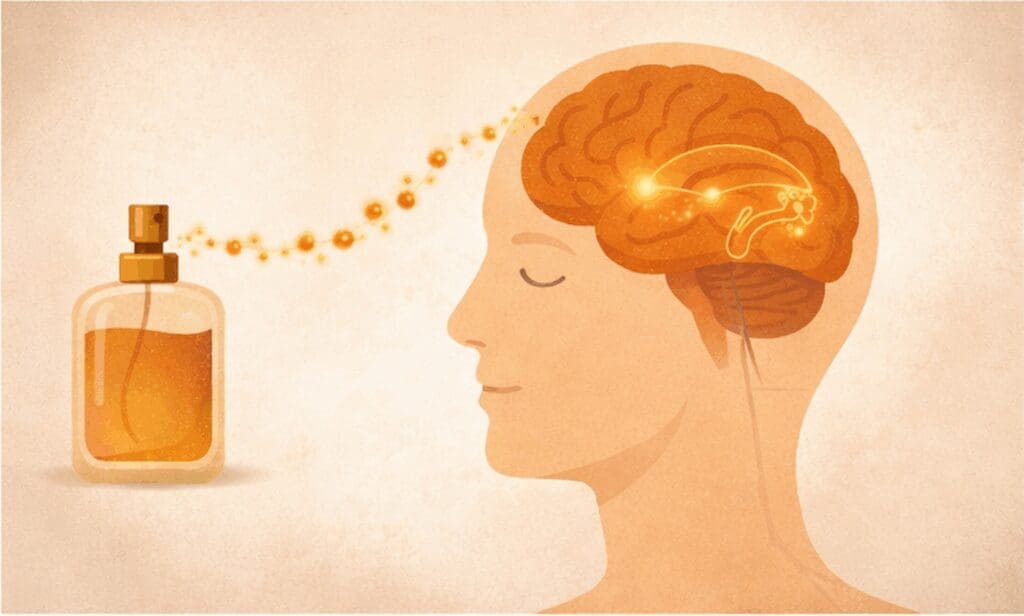
Why Smell Is the Most Emotional Human Sense
Long before fragrance became part of personal style, scent carried information. The smell of smoke could signal danger. Food aromas could signal nourishment. The familiar scent of a person or place could become associated with comfort, belonging, or safety.
That ancient relationship between smell, emotion, and memory is still part of the way we experience fragrance today.
The brain processes smell through pathways closely connected with regions involved in emotion and memory. That relationship helps explain why an aroma can sometimes bring back a person, place, life chapter, or emotional moment with surprising vividness.
Fragrance can become more than aroma. It can become connected to atmosphere, memory, identity, ritual, and the moments we carry with us.
The Science Behind Why Scent Feels So Emotional
When you inhale an aroma, odor molecules activate receptors in the nose. Those signals travel to the olfactory bulb and onward through networks of brain regions involved in identifying odors, evaluating their meaning, forming memories, and processing emotion.
Olfaction has especially close anatomical relationships with structures involved in memory and emotion, including areas associated with the amygdala and hippocampal memory system.
That does not mean every fragrance automatically produces a particular emotion. Our responses to scent are shaped by many things: previous experiences, personal associations, culture, context, expectations, and the circumstances in which we encounter an aroma.
This is one reason the same fragrance can feel comforting to one person, nostalgic to another, and entirely unfamiliar to someone else.
Why Fragrance Can Bring Memories Back So Vividly
Sometimes a fragrance does more than remind you that something happened. It seems to bring back part of the atmosphere surrounding the memory.
It may be the scent associated with a relative’s home, a particular season, a place you once lived, a celebration, a spiritual tradition, or a period of your life you have not thought about in years.
The fragrance itself did not create the entire memory. Instead, it became one element of the experience — and encountering it again can become a cue that helps retrieve what was associated with it.
The Fragrance Anchor™
At Fragrance & Things, we use Fragrance Anchor™ to describe a scent that becomes strongly connected with a memory, person, place, tradition, life chapter, experience, or emotional state.
The fragrance becomes meaningful because of what has become associated with it.
Why Ritual Can Strengthen a Fragrance Association
Repeated experiences give the brain opportunities to build associations. When the same fragrance appears during a recurring activity or meaningful moment, scent can gradually become one of the cues connected with that experience.
That might look like:
- Applying the same fragrance oil before evening reflection
- Burning Bakhoor before welcoming guests
- Using a particular scent during quiet personal rituals
- Wearing a signature fragrance during meaningful celebrations
- Returning to a familiar fragrance during a particular season or life chapter
Eventually, encountering that scent again may help bring the associated experience or feeling back to mind.
Ritual gives fragrance context.
Repetition gives it association.
Experience gives it meaning.
Why Fragrance Oils Can Feel Especially Personal
Fragrance oils create an intimate way to experience scent. Applied directly to selected areas of the skin, they become part of the wearer’s personal fragrance experience and develop alongside body warmth and the surrounding environment.
There is also something inherently intentional about applying an oil. Rolling or dabbing fragrance onto the skin creates a small moment of interaction rather than simply surrounding yourself with scent.
Within many Middle Eastern fragrance traditions, personal fragrance can also exist alongside Bakhoor, Oudh, hospitality, gathering, and home atmosphere. Fragrance is therefore experienced not only as something worn, but as something woven into moments and spaces.
Creating Your Own Fragrance Ritual
A fragrance ritual does not need to be elaborate. In fact, simplicity makes it easier to repeat.
Try a Simple Four-Part Ritual
- Choose a fragrance. Select an oil you genuinely enjoy rather than one you think you should wear.
- Choose a moment. Evening reflection, preparing for guests, getting ready for the day, or another recurring experience can become your ritual.
- Use it consistently. Allow fragrance to become one recognizable element of that experience.
- Notice the association. Over time, pay attention to what memories, feelings, places, or moments begin to come to mind when you encounter the scent.
For another example of how fragrance and repetition can become part of intentional practice, read our guide to creating a fragrance ritual during Ramadan and beyond .
Fragrance, Memory & Identity
Memory is only part of our relationship with fragrance. Over time, the scents we repeatedly choose can also become part of how we express ourselves.
You may notice that certain fragrance experiences consistently feel more aligned with your presence, character, emotional needs, or the atmosphere you enjoy creating.
That does not mean one ingredient automatically determines your Fragrance Identity. Loving musk does not, by itself, make someone Soft Musk, just as enjoying Oudh does not automatically make someone Royal Oudh.
Fragrance Identity is broader. It considers the kind of presence, experience, and emotional character you repeatedly gravitate toward.
What Does Your Fragrance Say About You?
F&T Fragrance Intelligence recognizes five fragrance identities: Royal Oudh, Soft Musk, Clean Luxury, Sacred Ritual, and Modern Sweet.
Rather than guessing from a single fragrance note, the Fragrance Identity Quiz explores the broader scent experience and presence you naturally gravitate toward.
Discover Your Fragrance Identity
Your fragrance preferences can reveal patterns in the presence and scent experience you repeatedly choose. Discover which of the five F&T Fragrance Identities most closely reflects you.
Take the Fragrance Identity QuizThe Fragrances That Follow Us Through Life
Our relationship with fragrance does not remain frozen.
The scent that represents one period of life may eventually give way to something different. New places, relationships, traditions, experiences, and changing preferences can introduce new associations.
A fragrance you wore years ago may preserve one chapter while another becomes connected with who you are today.
The fragrances we remember most are often not simply the ones we smelled. They are the ones that became part of something meaningful.
Explore the Ritual of Fragrance
At Fragrance & Things, fragrance is more than something you put on. It can be something you discover, experience, remember, and intentionally make part of your life.
Whether through personal fragrance oils, Bakhoor in the home, Oudh traditions, layering, or a recurring scent ritual, fragrance can become part of the atmosphere surrounding meaningful moments.
Continue Your Fragrance Journey
Explore personal fragrance and traditional scent rituals, or begin by discovering the Fragrance Identity that feels most aligned with you.
Explore Home Fragrance Rituals
Interested in experiencing fragrance beyond personal wear?