The Science of Scent: How Fragrance Connects With Mood, Memory, and the Brain
Why Smell Can Feel So Emotional—and How Experience Turns Fragrance Into Memory and Meaning
A fragrance can sometimes reach us before we have found the words to describe what we are feeling.
A familiar aroma appears, and suddenly a person, place, celebration, home, or chapter of life feels unexpectedly close again.
Another scent may feel comforting simply because we have encountered it during meaningful moments. A fragrance worn repeatedly during an important season of life may eventually become inseparable from the memories created there.
This emotional immediacy is one of the most fascinating features of the human sense of smell.
But the science is more nuanced than saying fragrance “bypasses logic,” controls emotion, or directly programs the brain.
Fragrance does not simply enter the brain and create an emotion. Scent is perceived, interpreted, associated, remembered, and given meaning through experience.
Understanding that process gives us a much richer way to think about fragrance—and explains why the same aroma can mean something profound to one person and almost nothing to another.
Why Smell Has Such a Close Relationship With Emotion and Memory
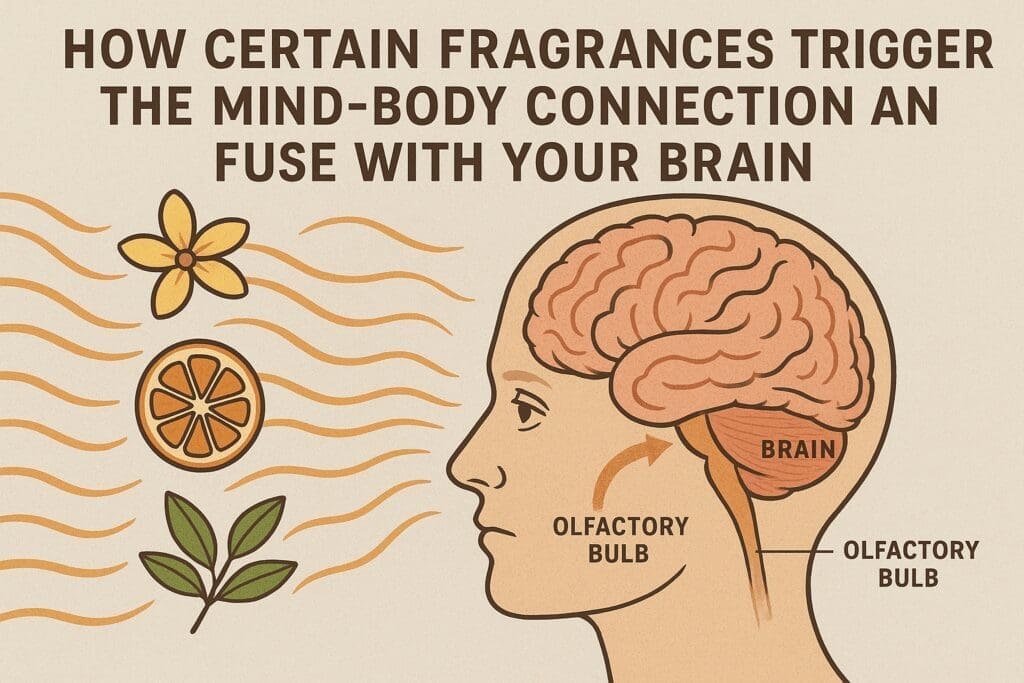
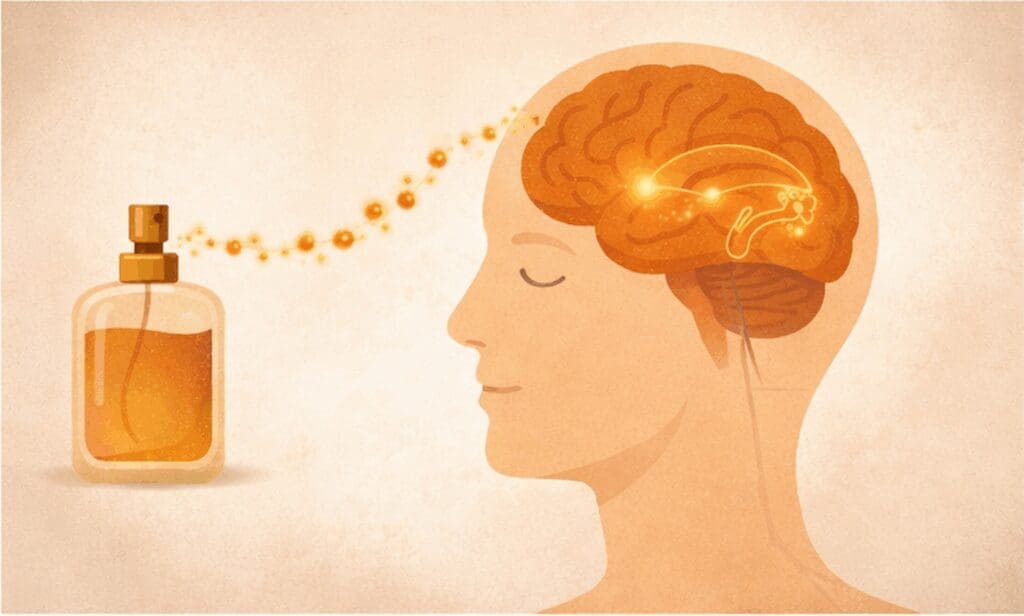
When odor molecules reach receptors inside the nose, the resulting signals travel into the olfactory system, beginning with structures that help the brain process and identify smell.
Olfactory pathways have particularly close anatomical relationships with brain regions involved in memory and emotion, including the amygdala and hippocampal system.
This does not mean that smell completely bypasses thinking or conscious interpretation. Fragrance perception also involves broader brain networks associated with attention, expectation, evaluation, language, and context.
What makes olfaction distinctive is the unusually close relationship between sensory processing, emotion, and memory.
That helps explain why an odor can sometimes feel emotionally significant before we can immediately identify exactly what it reminds us of.
Smell Is Not Experienced in Isolation
We do not experience fragrance as a collection of molecules alone.
Our interpretation is influenced by:
- past experiences;
- familiarity;
- expectations;
- culture;
- the setting in which the fragrance appears;
- the people associated with it;
- our current emotional state;
- what we believe the fragrance represents.
This is why scent perception is deeply personal.
Two people can encounter the same fragrance and form entirely different impressions—not because one person is perceiving fragrance “correctly” and the other is not, but because each person brings a different history of associations into the experience.
This principle sits at the heart of Fragrance Intelligence™.
Why Fragrance Can Trigger Powerful Autobiographical Memories
Researchers have long studied what is sometimes called the Proust phenomenon: the ability of odors to evoke autobiographical memories with unusual emotional vividness and a strong feeling of being transported back in time.
Not every fragrance produces a dramatic memory, and not every memory triggered by scent is more powerful than one triggered by sight or sound.
But research suggests that odor-evoked autobiographical memories can have distinctive characteristics, including strong emotional qualities and a heightened sense of returning to an earlier experience.
Consider what happens when you unexpectedly encounter:
- a musk that reminds you of a grandparent;
- Bakhoor associated with family gatherings;
- the fragrance you wore during an important accomplishment;
- an Oudh composition connected with someone you once knew;
- an aroma associated with Ramadan, Eid, travel, marriage, childhood, or a particular home.
The aroma does not contain the memory inside it.
The connection developed through experience.
Fragrance Anchors™: When Scent Becomes Connected to a Life Experience
At Fragrance & Things, we use the term Fragrance Anchor™ to describe a scent that has become strongly connected to a meaningful memory, person, place, tradition, life chapter, experience, or emotional state.
The idea is not that the fragrance somehow stores the memory.
Rather, repeated or emotionally significant experiences can build an association between the aroma and what was happening when it was encountered.
Later, smelling that fragrance again can help retrieve parts of the associated experience.
How a Fragrance Anchor™ Can Develop
SCENT
↓
EXPERIENCE
↓
ASSOCIATION
↓
MEMORY
↓
MEANING
This is one reason fragrance can become far more personally significant over time than it seemed when first encountered.
Does Fragrance Change Your Mood?
This question deserves careful language.
Odors can influence subjective experience, and research has explored relationships between scent, emotional response, stress, pleasantness, autobiographical memory, and physiological measures.
But there is no universal rule such as:
- one fragrance always creates calm;
- another always improves concentration;
- another automatically creates confidence;
- another reliably reduces anxiety.
Individual response matters enormously.
A fragrance one person experiences as soothing may remind another person of an unpleasant experience. A scent marketed as relaxing may simply be unfamiliar or unappealing to someone else.
The meaning of a fragrance is partly chemical—but it is also learned, contextual, and personal.
Why Familiarity Can Matter as Much as the Aroma Itself
A familiar fragrance arrives with history.
If a scent repeatedly appears during comforting experiences, celebrations, meaningful routines, or time spent with people we love, the fragrance may eventually acquire some of those associations.
This helps explain why one person’s idea of a comforting fragrance may be completely different from another person’s.
For one person, comfort may smell like soft musk.
For another, it may be rose.
Someone else may associate Oudh or Bakhoor with home, family, hospitality, or religious and cultural occasions.
The aroma matters—but so does everything the aroma has come to represent.
Can We Intentionally Build New Fragrance Associations?
Associative learning is a fundamental feature of human memory.
If a particular fragrance is repeatedly experienced during the same kind of activity, the scent can gradually become associated with that routine.
For example, someone might choose one fragrance specifically for:
- quiet reading;
- preparing for an important meeting;
- evening reflection;
- hosting guests;
- journaling;
- studying;
- family gatherings;
- special celebrations.
Over time, encountering the fragrance may remind the person of that activity or the state of mind commonly associated with it.
That does not mean the fragrance has medically “trained” the nervous system or guarantees a particular physiological response.
It means the fragrance has become a learned cue within a repeated experience.
Fragrance, Routine, and Intention
This is where fragrance can become useful without requiring exaggerated claims about what scent can do.
You can intentionally give fragrance a role.
Give Fragrance a Purpose
PREPARATION
Choose a fragrance you consistently wear while preparing for important professional or personal moments.
REFLECTION
Allow a familiar aroma to become part of a quiet routine, journaling practice, or contemplative environment.
HOSPITALITY
Use a consistent Bakhoor or home-fragrance profile when preparing your space for guests.
CELEBRATION
Reserve a distinctive fragrance for meaningful occasions and allow new memories to form around it.
The goal is not to force an emotion.
The goal is to allow fragrance to become part of an intentional experience.
When Human Body Odor Carries Social Information
Another fascinating area of olfactory research examines whether naturally produced human body odors can carry information about emotional states.
Studies involving body odor collected during fear, stress, or anxiety have reported measurable effects on other participants’ perception or behavior, and broader analyses suggest that some forms of emotional information may be communicated through human body odor.
This research is still developing, and it should not be simplified into the claim that every emotion has a predictable “smell.”
More importantly for fragrance education:
Human emotional chemosignals and commercial fragrance oils are not the same phenomenon.
Research involving compounds naturally present in human sweat does not demonstrate that applying a fragrance oil can chemically transmit confidence, trust, attraction, fearlessness, or another emotional state to people nearby.
Fragrance can certainly shape impressions and become part of social experience, but those effects also involve expectations, culture, personal preference, memory, context, and the relationship between the people involved.
Why Fragrance Is Social as Well as Personal
Even without making strong biological claims, fragrance clearly participates in social life.
People may remember:
- the fragrance someone consistently wears;
- the Bakhoor associated with a particular home;
- the scent present during a wedding or celebration;
- the aroma of a relative’s clothing;
- a fragrance connected with a workplace, journey, hotel, shop, or neighborhood.
Those associations demonstrate an important principle:
Fragrance becomes meaningful not only through what we smell, but through who, where, and what becomes connected to the scent.
Cultural Memory and Middle Eastern Fragrance
Fragrance also exists within culture.
Oudh, Bakhoor, rose, musk, amber, sandalwood, and other familiar aromatic references may carry meanings shaped by family practices, hospitality, regional traditions, religious occasions, personal history, and community experience.
That does not mean everyone from the same culture interprets a fragrance identically.
Individual experience still matters.
But cultural context can influence what an aroma represents before personal memories add another layer of meaning.
This is one reason Middle Eastern fragrance should not be understood only as a collection of exotic ingredients.
Fragrance can also participate in hospitality, identity, atmosphere, continuity, and memory.
The Relationship Between Smell and Mental Health Is Complex
Research has also examined relationships between olfactory function and conditions such as depression and neurological disease.
For example, reduced or altered smell function has been associated with depression in some populations, although the relationship is complex and research continues to investigate direction, mechanism, and individual differences.
That finding should not be turned backward into a claim that fragrance can prevent or treat depression.
An association between smell function and a health condition is not evidence that wearing fragrance oil treats that condition.
What Fragrance Science Does Not Mean
The science of smell is fascinating enough without turning every research finding into a wellness promise.
Important Distinctions
FRAGRANCE IS NOT MEDICAL TREATMENT
Fragrance oils should not be presented as treatments for depression, anxiety, neurological disease, chronic pain, or other medical conditions.
INDIVIDUAL RESPONSES VARY
A fragrance that one person experiences as comforting, energizing, or nostalgic may produce a completely different response in someone else.
ASSOCIATION IS NOT CAUSATION
Research connecting smell function with health conditions does not mean fragrance can prevent or reverse those conditions.
BODY-ODOR RESEARCH IS NOT PERFUME RESEARCH
Studies of naturally occurring human chemosignals should not be used as proof that commercial fragrance products biologically transmit emotional states.
Being careful with these distinctions strengthens fragrance education rather than weakening it.
From Scent to Meaning: The Fragrance Intelligence™ Perspective
Science can help explain why smell has such close relationships with memory, emotion, and learning.
Fragrance Intelligence™ asks what happens after perception begins.
Fragrance Intelligence™
How Scent Becomes Personally Meaningful
SCENT
↓
PERCEPTION
↓
ASSOCIATION
↓
MEMORY
↓
MEANING
The journey is not identical for everyone.
That is precisely why fragrance can become so personal.
Use Fragrance to Create Meaning—Not to Control Emotion
The most useful way to apply fragrance science is not to ask:
“Which fragrance will make me feel a specific emotion?”
A more meaningful question is:
“What experiences do I want this fragrance to become part of?”
You might choose a fragrance for an important life chapter.
Wear another when preparing for meaningful work.
Burn Bakhoor when welcoming people into your home.
Reserve a distinctive aroma for celebrations.
Or simply allow a fragrance you love to accompany ordinary days until those days eventually become memories themselves.
Your Brain Does More Than Smell Fragrance
Fragrance begins as sensory information.
But our experience of scent does not end in the nose.
The brain interprets.
Experience associates.
Memory preserves.
Culture adds context.
And over time, people give fragrance meaning.
The power of fragrance is not that scent controls the mind. It is that the human mind can turn scent into memory, identity, atmosphere, and meaning.
If you would like to continue exploring the relationship between fragrance and human experience, read Why Your Favorite Fragrance Says More About You Than You Think and Why Your Fragrance Preferences Change Over Time.
The Fragrance & Things Knowledge Journey
From Scent
to Memory and Meaning
Understanding the science of smell gives us a foundation. Fragrance Intelligence™ helps us understand what happens when scent becomes part of our identities, experiences, memories, and lives.
Continue Learning
MEMORY & GROWTH
What Has Fragrance Come to Mean to You?
Your fragrance preferences are shaped by more than notes. Discover the identity that most naturally reflects the fragrance experiences you are drawn toward.
Take the Fragrance Identity Quiz →Create New Fragrance Memories
Explore authentic fragrance oils and discover the scents that may accompany the experiences and chapters still ahead of you.
Explore Fragrance Oils →