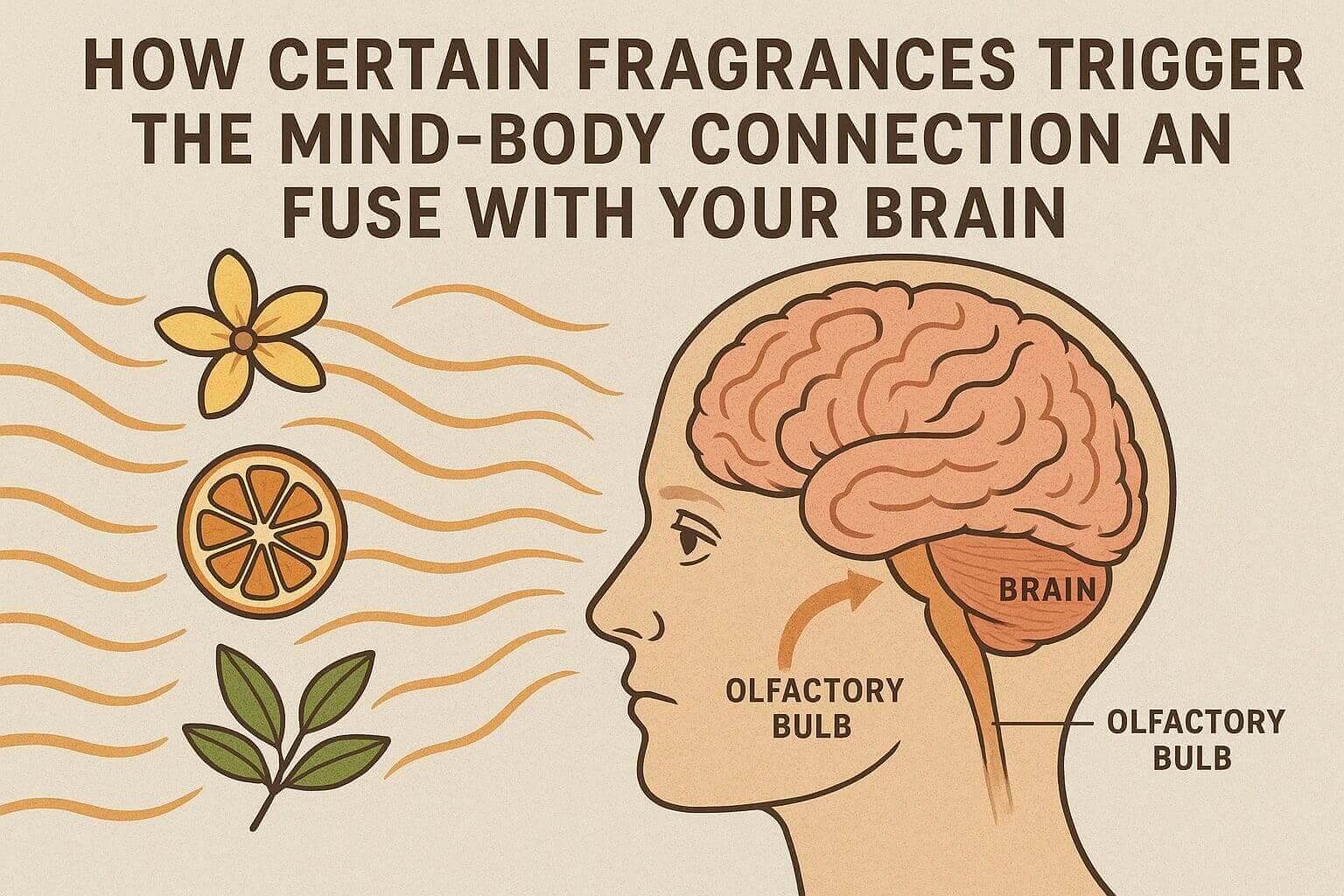
How Certain Fragrances Trigger the Mind-Body Connection and Fuse with your Brain?
Olfaction, also known as the sense of smell, is the most primal yet mysterious of your six senses. Throughout human evolution, the sense of smell has always been key to survival. The sense of smell is what makes humans capable of distinguishing thousands of unique odors.
More often than not, the smell is the first warning sign of danger or safety, friend or foe. Smells have that power to influence your behavior on a subconscious and instinctive level. Luckily, it is possible for you to harness the power of smell and use it to your advantage.
It is still ironic that most people tend to undervalue the power of fragrances. From an evolutionary point of view, a negative smell can trigger an instantaneous reflex to move away whereas a positive smell such as that of baked cookies can trigger the urge to befriend others while you rest and digest.
Fragrances have the power to have positive effects on mood, enhance sleep, and reduce stress while improving self-confidence, and cognitive and physical performance. By becoming more aware of the way different fragrances affect you personally, you can enhance your health and well-being.
Did you know you can sense emotions through Chemosignals?
A new study has found it is possible to smell human emotions. The researchers at the Utrecht University of the Netherlands have found that it is possible for people to “smell” emotions such as disgust or fear through excreted chemical signals. Smelling these chemo signals provokes the same emotional response – smelling “fear” provokes a facial expression indicative of fear.
For the study that was published in the journal Psychological Science, the researchers selected a few male study participants and asked them to watch horror movies that induced feelings of fear or disgust. For the two days before they watched the movie, they were instructed to be careful about smell contamination i.e. they shouldn’t drink alcohol, smoke, eat smelly foods, exercise a lot, or use their detergents in excess.
Once the participants watched the movies, the researchers gathered sweat samples from each one of them. Then, the researchers chose a few female study participants to perform a visual task, all while being exposed to those sweat samples collected earlier. As they were performing the task, their eye movements and facial expressions were monitored.
It was then found out that the eye movements and facial expressions of those women were indicative of the kind of sweat sample that they smelled, providing they also produced facial expressions indicative of fear.
This isn’t the first time it has been shown that it is indeed possible to smell the emotions of other people. Another study presented at the Association for Psychological Science meeting in 2010, by researchers at Rice University, found out that people who are in a close romantic relationship can smell emotions like happiness, sexual arousal, and fear in each other.
Memory’s Muse
According to Herz, a fragrance has no personal significance, until it becomes connected to something or someone that has meaning. During your initial encounter, you start forming nerve connections that intertwine the fragrances with emotions. The capacities for both emotion and fragrance are rooted within the limbic system, the same network of brain structures. The olfactory center also starts interacting directly with the hippocampus, the area in the brain that is involved with the formation of new memories.
On a practical level, this means that you might be able to use your sense of smell for prompting your memory when taking an important test. Herz’s research suggested that your ability to recall specific information may improve by inhaling the aroma of pleasant fragrance oil that you breathed while absorbing information. So keep your favorite fragrance oil handy while studying, and then bring a vial of that fragrance oil to your important test.
You can even use smells for evoking a loved one during the periods you’re apart. Herz said that smelling a reminder of your loved one, perhaps that person’s perfume oil fragrance or a used T-shirt. Smell can really conjure the person, more than looking at a photo. You’ll actually get the feeling of that person more from the scent.
In the line of fragrance: The mind-body connection
Given the intimate connection between fragrance and emotion, it is not surprising that a small glitch in one can attribute to problems with the other one. Anosmia – complete loss of sense of smell leads to depression. Conversely, those who suffer from severe depression show a diminished sensitivity to fragrances.
A decline in the ability to smell might be an early sign of neurological disorders like Alzheimer’s, Parkinson’s, and Huntington’s diseases. Theoretically, practicing a sense of smell can be associated with better neurological well-being, but this hasn’t been proven yet. As a significant link in your mind-body connection, you can deploy your sense of smell for improvement in pain tolerance. Any pleasant fragrance can act as a distraction and lift your mood. Some studies have suggested that sweet smells might work best. Sweet tastes are known to reduce pain by activating opioid systems in the brain; whereas sweet fragrances can also activate the same systems, says Australian psychologist John Prescott, a visiting scholar at Oxford University.
You can even use your sense of smell to deliver instant relaxation, according to Pamela Dalton, a sensory psychologist at the Monell Chemical Senses Center, in Philadelphia. Choose calming Middle Eastern fragrance oil and pair the aroma of that fragrance oil with a calming meditation session. After a few sessions, the fragrance itself will elicit a relaxed state even when you don’t have enough time to meditate.
Cultivating a signature fragrance for yourself
Fragrances help you perform better on tests or cope with pain more effectively while also helping you form better first impressions on others. Choose a personal fragrance oil carefully, keeping in mind the common cultural associations. A woody or mossy fragrance exudes earthiness, for example, while musk fragrances connote sexiness. If you’re looking to be remembered, pick a distinctive Middle Eastern fragrance oil that not many people have encountered. Make sure that you don’t drench yourself in cologne. Just because your nose adapts to your fragrance after 15 minutes, that doesn’t mean the people you meet can’t smell it. Middle Eastern fragrance oils are typically more potent than many perfumes and colognes. So, do not overwhelm those you come into contact with.
Improve your office environment for improved productivity
If you’ve found out the perfect fragrance for you, why not spice up the air in your office environment? Try aromatherapy to make your office environment into a positive working space. Aromatherapy is the usage of essential oils to improve a person’s psychological well-being and mood as the smell is the strongest of all senses and it can boost your brain activity and improve productivity.
For the benefit of your office team, try using different fragrance oils during a working session that requires you to stay focused. The resulting effects will surprise even the most positive people out there. Here are a few great Middle Eastern fragrance oil flavors that are recommended to boost the mood and improve productivity within the office.
- Peppermint
Peppermint isn’t just a plant that is commonly used in chewing gums and toothpastes to freshen your breath. Peppermint also helps you clear your mind. The peppermint fragrance is known to boost attentiveness. In a brainstorming session, you can use peppermint fragrance oil and invigorate the minds and your team will come up with all the right ideas.
- Citrus
Studies in Japan have found out that typing errors were reduced by over 50% in the presence of lemon fragrance. Lemon increases focus and attentiveness while its antibacterial properties help fight cold and boost your body’s immune system. But lemons aren’t the only citrus flavors that offer benefits as grapefruits also help fight mental fatigue while oranges ease anxiety.
- Cinnamon
If you’re working in an office environment, you’ve probably experienced the infamous “2:30 crash” at some point in time. The primary reason for that is due to an unbalanced lunch, low in fiber and high in carbohydrates. To combat that, try eating healthier and introduce the fragrance of cinnamon because cinnamon helps fight mental fatigue while reducing the feeling of curling up and hibernating.
- Jasmine
Jasmine has been used for thousands of years in Asia as it not only makes great green tea but it also helps improve metabolism. Jasmine dispenses a highly fragrant and subtly sweet aroma that helps calm nerves and creates a feeling of confidence. Jasmine fragrance has a great fragrance and it has a calming effect on the body.
- Chamomile
Chamomile is actually a fragrance that you should use at home during the evening/night time. This is a daisy-like plant that is useful in making herb infusions to help you relax. Evidence is that chamomile possesses anti-anxiety properties and is useful in treating insomnia and stress. If you’re having a stressful night, chamomile fragrance can help you during distress and fall asleep sooner. After all, this is the main ingredient for enhancing productivity and later get a good night’s sleep. Give your team a chamomile gift bag and help them improve their productivity with this kind gesture.