Fragrance and Emotions – How does Fragrance Affect the Human Brain?
Your mental state is often influenced and dominated by olfactory experiences that guide your senses. Whether it is a rose that looks freshly watered or an apple that looks rotten, behind the scenes it is your sense of smell that is responsible for identifying such sensations. The brain often triggers the sense of smell even before the aroma molecules have made it past your nostrils, thanks to the fact that your vision automatically relates images to certain smells and vice versa. All this happens rapidly and subconsciously, thanks to the biological survival instincts in humans. But what is a smell, really? Can it be separated from your other senses? Why do certain fragrances evoke certain emotions?
The Anatomy of Fragrances
The word perfume is derived from perfumare, a Latin word that means “to smoke through”. In fact, perfumery is the art of making perfumes while a perfumer is a person who creates fragrances.
The roots of the art of perfumery go as far back as ancient Mesopotamia and Egypt while it was refined by the Persians and Romans. Creating a compelling Middle Eastern Fragrance oil requires a harmonious mixing of tens or potentially hundreds of natural or synthetic aromatic chemicals. Typically, the perfumers create 3-tiers of “fragrance notes” including top notes, middle heart notes, and base notes that unfold overtime as the fragrance starts mixing with the natural oils of your skin.
The top notes tend to be light, citrusy, and often dissipate quickly while the middle and bottom notes are deeper aromas and typically depicted as woodsy or earthy. You can find around 800 to 1,500 different aroma characteristics in a complex fragrance.
Trying to create an emotional tone through a certain fragrance is a complex scientific process. Each fragrance contains a unique blend of natural and synthetic substances, including man-made synthetic smells, and essential oils extracted from plants and flowers. The subtle scents found within different aspects of fragrance oil blend with an individual’s own chemistry and add to the signature scent’s Proustian allure.
How do humans detect fragrances?
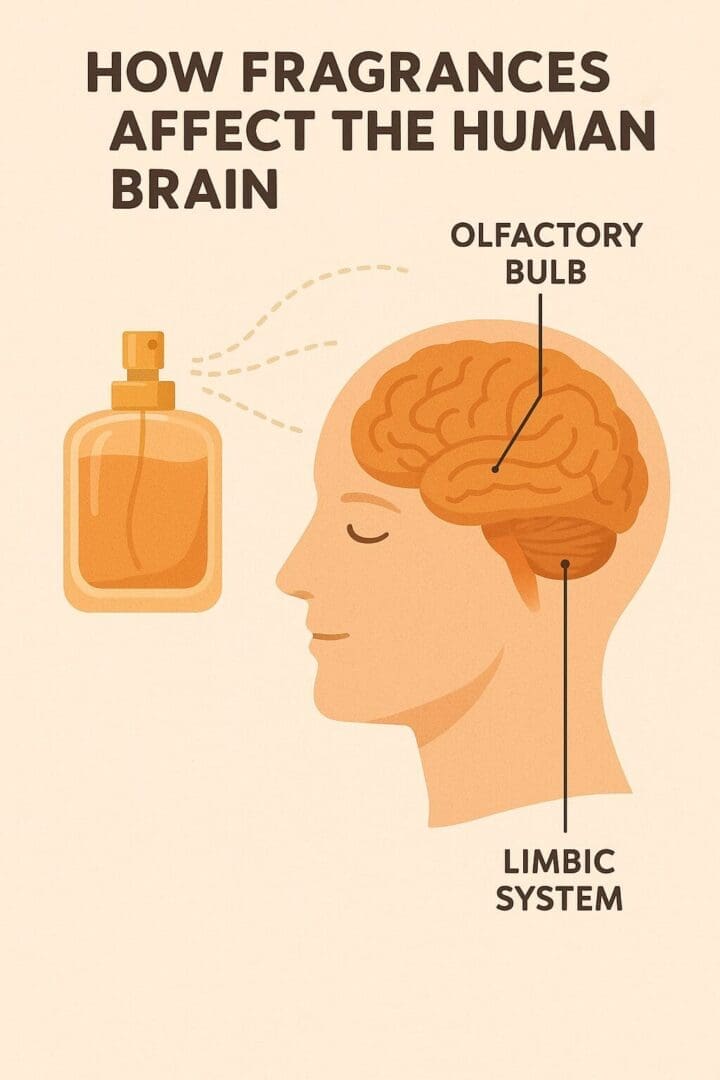
When people sniff any fragrance through deodorants, perfumes, or fragrance oil, the odor molecules are drawn in via the olfactory cleft inside their nose. The odor molecules then dissolve and penetrate through the mucous membrane, which is also referred to as the olfactory epithelium. Turbinate or Bony Cushions, located in your nose then assist the intake of air that contains these odor molecules, filtering and directing the flow of air.
Cilia, the hair-like projections that are attached to the receptor cells bind the now-dissolved odor molecules, generate an impulse that travels through the olfactory nerves and reaches the olfactory bulb in your brain. It is this part of the brain where these signals are processed and passed onto the other parts of the brain.
Why do fragrances trigger remembrance of things or past events for you?
Fragrances and smell, in general, are often linked to early life experiences that are saved in your memory. This is illustrated very well by the author Marcel Proust in his “In Remembrance of Things Past” as he vividly describes the way forgotten childhood memories come back into consciousness with the original intensity once the protagonist in his book dips a madeleine biscuit into the cup of tea.
Such instances are referred to as the “Proustian memory effect”. Childhood memories that are linked to certain fragrances or scents stay with you throughout life. Recently, Haruko Sugiyama and Rachel Herz of Brown University, colleagues at the Japanese Kao Corporation conducted a study that identified how certain fragrances evoke personal emotional memories and how they influence the appeal of a certain product to consumers.
Their June 2015 study titled “Proustian Products are Preferred: The Relationship Between Odor-Evoked Memory and Product Evaluation”, was published in the journal Chemosensory Perception.
In this study, Herz and colleagues tested how odor-evoked memories influenced the perception of customers toward different products. Such “Proustian memories” are generally formed early in life, and are powerful in driving human behavior.
They performed an experiment by using samples of four fragrance body lotions. These samples were sent to 271 women between the ages of 22 and 31 years. The participants had to rate the lotion fragrances on the basis of five qualities – intensity, pleasantness, uniqueness, familiarity, and the degree to which the lotion elicited personal memories. As a follow up to the survey, each participant had to rate how much they liked the lotion.
The researchers found that the lotion fragrances that had a pleasant fragrance and evoked stronger personal emotional memories got a preference from most of the participants. The emotional responses to the smell varied from person to person depending on their personal experience. For example, some loved the smell of petrol, because of the positive childhood memories of going on trips with their dad and stopping for a gas refill. While others found it disgusting and weird.
The idiosyncrasies of fragrance-related perception are determined largely by your personal history and prior learning, but there are geographic and cultural variations in play too. In Europe and North America, lavender is perceived to be a calming fragrance while citrus scents are perceived to be bright and happy smells. However, in Japan, the fragrance of jasmine is associated with a relaxed mood whereas rose water is viewed as an energizing and happy scent.
The intensity of Proustian memories that were evoked by different product fragrances came out to be a prime driving force in motivating consumer behavior. The more vivid the childhood memories the fragrance triggered the higher the odds that someone will purchase products with that fragrance.
Even though this study was about using fragrances to drive consumer behavior, the fragrance that you choose to surround yourself with also drives your personal behavior in positive ways. In fact, the fragrances that you surround yourself with are in the locus of your control. Put yourself in the driver’s seat and use fragrances as tools to create a positive mindset and increase your motivation for achieving your targets.
Why do fragrances trigger emotion?
Memories are often intertwined with emotions. For instance, when you’re reminiscing about your summer vacations, do you often remember the feeling of joy and freedom? Memories are associated with automatic emotions. Therefore, if you experience a fragrance that is stored in your memory, your brain will correlate it with certain emotions involved with their emergence in tandem. Consider a childhood memory involving the smell of freshly baked cookies. The smell might remind you of the afternoons you spend with your grandparents a long time ago. You can even consider the example of the fragrance oil that your partner was wearing on your first date. Anytime you smell that fragrance, doesn’t it invoke emotions and memories reminding you of your first date?
The smell is the most sensitive sense in humans and it is strongly linked to feelings and memory. Your olfactory bulb that begins inside your nose and runs along the bottom of your brain, is the first pitstop for new smells. The olfactory bulb is linked directly to two areas of your brain that govern memory and emotion – the hippocampus and the amygdala. Memories that are triggered by your olfactory senses are usually accompanied by feelings of happiness, agony, excitement, and even despair.
Do different fragrances affect your mood?
The way your brain receives and processes fragrances is very complex and much of it still remains a mystery. However, there is no doubt that fragrances do affect your mood. People who walk into a room that smells of vanilla, jasmine, or lavender will more likely improve their mood whereas if the room smells unpleasant, they’ll more likely feel the opposite.
Smells indeed affect your short-term and long-term moods. Creating an environment with a pleasant fragrance will evoke calm and positive emotions. It is rather simple and will have a profound impact on your mood. Evidence to that would be the increased use of aroma diffusers these days that are used to ensure a good fragrance in the room.
How are fragrances used in your everyday life?
Fragrances are used in everyday life for eliciting emotional responses. Take sales and advertising for example. Have you ever noticed a distinct smell of fragrance oil when walking into a nearby store? Fragrances can be associated with products or even be used to keep the customers around. Providing a pleasant-smelling environment leads to increased sales and most stores these days make use of perfume oil fragrances for these exact purposes.
Similarly, fragrances are also useful in classroom settings or in workplaces. Certain smells influence parts of your brain that are responsible for productivity. In a few schools, the teachers have begun the practice of using diffusers in the classrooms by associating it with different subjects to calm down rowdy children and to stimulate brain activity. The same can be observed in workplaces. Placing an aroma diffuser or using an authentic Middle Eastern fragrance oil in the office can improve the mood of the employee, thus improving their productivity and contributing to a happier work environment.