How Fragrance Affects Mood, Memory, and Work Performance
Have you ever encountered a familiar fragrance and suddenly remembered a place, a person, or a moment you had not thought about in years?
A trace of perfume may recall someone you once knew. The aroma of incense may bring back a family gathering, a sacred occasion, or a quiet evening at home. Sometimes the memory appears before you can consciously identify what you are smelling.
This is part of what makes fragrance so powerful. Smell is not merely a way to detect pleasant or unpleasant aromas. It is closely connected with memory, emotion, learned associations, perception, and the atmosphere of everyday life.
Fragrance may also affect how comfortable, alert, focused, or emotionally settled a person feels in a particular environment. However, these responses are not universal. They can depend on personal history, cultural background, expectation, context, fragrance preference, and the task being performed.
Understanding those differences gives us a more intelligent way to think about fragrance—not as a guaranteed tool for producing a specific reaction, but as a sensory influence that can become deeply meaningful through experience.
Why Is Fragrance Such a Powerful Influence?
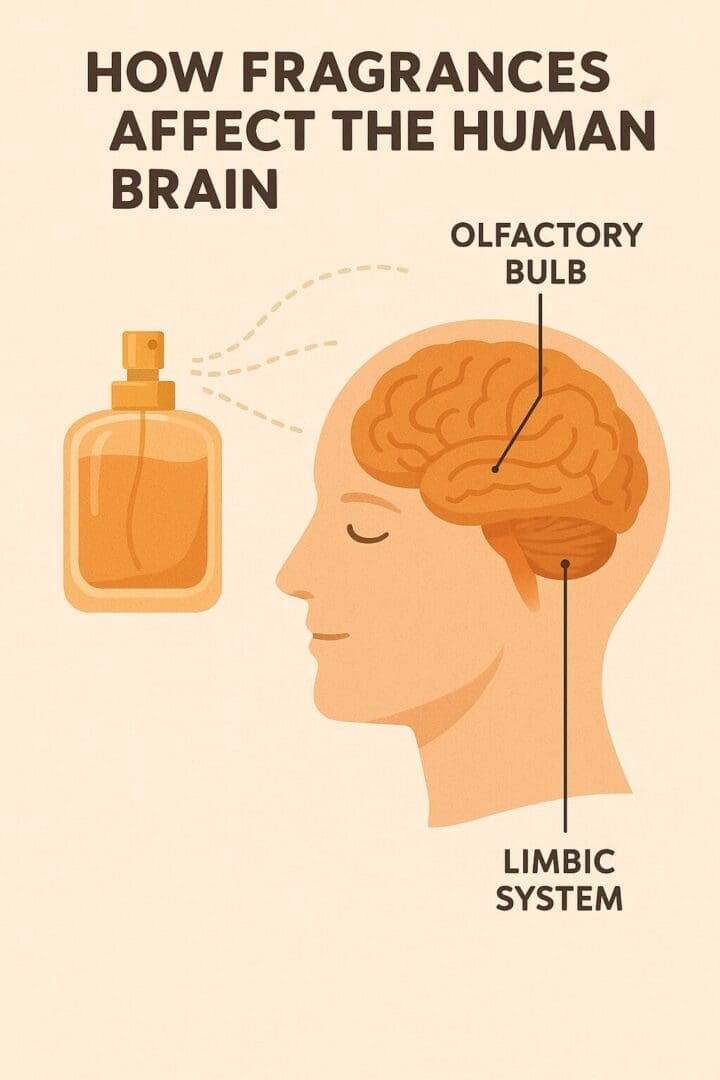
Fragrance can feel immediate because the olfactory system has close connections with brain regions involved in emotion and memory. When aromatic molecules enter the nose, specialized receptors detect them and send signals toward the olfactory bulb. From there, information is communicated with several areas of the brain, including regions associated with emotional processing and memory formation.
This relationship helps explain why an aroma may evoke an emotional response before you have fully identified it. You may experience familiarity, comfort, uneasiness, nostalgia, or curiosity and only afterward recognize the scent that prompted the response.
Fragrance is therefore not experienced as chemistry alone. It is interpreted through the mind, the body, and the accumulated history of the person smelling it.
How Your Sense of Smell Works
When you inhale, airborne aromatic molecules enter the nasal cavity. Some reach a specialized area containing olfactory receptor cells. These receptors respond to molecular features and convert that information into neural signals.
The signals travel to the olfactory bulb, where the brain begins organizing the sensory information. That information is then shared with other brain regions that contribute to recognition, memory, emotion, attention, and decision-making.
What you consciously recognize as a fragrance is therefore the result of several processes working together. The brain must detect the aroma, compare it with previous experiences, interpret its context, and determine whether it seems familiar, pleasant, unpleasant, important, or neutral.
This is one reason fragrance can be difficult to describe. You may immediately know that an aroma feels warm, comforting, elegant, sharp, sacred, or familiar even when you cannot name its individual notes.
Fragrance, Memory, and Associative Learning
Many fragrance responses develop through associative learning. This occurs when the mind connects one experience with another.
Suppose a particular aroma is present during repeated family celebrations. Over time, that fragrance may become associated with hospitality, belonging, anticipation, or joy. Encountering it years later may revive part of the emotional character of those occasions.
The same principle can work in the opposite direction. A fragrance encountered during an uncomfortable experience may later produce hesitation or dislike, even when the aroma itself is not inherently unpleasant.
This helps explain why two people can smell the same fragrance and form completely different opinions. One person may interpret a dense woody fragrance as luxurious and reassuring. Another may find it unfamiliar or overwhelming. Neither response exists in isolation; each is shaped by experience, expectation, familiarity, and context.
Fragrance does not arrive in an empty mind. It meets the memories, expectations, and experiences already living there.
Can Fragrance Memories Begin Early in Life?
Our relationship with aroma begins early. Research into flavor and odor learning indicates that exposure can begin before birth and continue through feeding, physical closeness, family environments, cultural practices, and everyday routines.
During childhood, aromas may become connected with people, foods, homes, holidays, places of worship, personal-care products, and moments of affection or security. These associations can influence later preferences, although they do not determine them permanently.
People continue forming new associations throughout life. A fragrance worn during a major achievement, journey, marriage, religious season, or personal transition may eventually become part of how that period is remembered.
This is why fragrance can function as a marker of time. It can represent not only what you smelled, but also who you were, where you were, and what the moment meant to you.
Does Fragrance Affect Your Mood?
Fragrance can influence mood, but not in a simple or completely predictable way.
A pleasant aroma may contribute to a more agreeable environment, while an unpleasant or intrusive odor may create discomfort. Yet the effect of a fragrance depends heavily on whether the person likes it, recognizes it, expects it, and considers it appropriate for the setting.
For example, one person may associate a floral fragrance with freshness and optimism. Another may consider the same profile too strong or reminiscent of an unwanted memory. A woody aroma may communicate calm and refinement to one person while feeling heavy to another.
For that reason, claims such as “lavender always relaxes” or “citrus always energizes” are too absolute. Particular fragrance families may be commonly associated with certain impressions, but individual responses vary.
A more responsible conclusion is that fragrance can help shape the sensory and emotional character of an environment. The result depends on the fragrance, the person, the setting, and the associations involved.
Expectation and Context Matter
The same fragrance may be interpreted differently depending on where and when it is encountered.
Incense that feels meaningful during a spiritual or cultural ritual may seem out of place in a small professional environment. A fragrance that feels elegant during an evening gathering may be distracting when applied too heavily in a shared workspace.
Expectation also influences perception. When someone is told that a fragrance is rare, luxurious, clean, natural, traditional, or modern, that description may affect how the aroma is evaluated. Packaging, setting, storytelling, and prior knowledge can all contribute to the experience.
This does not mean fragrance perception is imaginary. It means that sensory interpretation is complex. The aroma itself matters, but so do the conditions under which it is experienced.
Fragrance and Personal Perception
Fragrance may influence how people perceive themselves and how they believe they are being perceived by others.
A carefully selected fragrance may help someone feel more polished, composed, expressive, or prepared. That shift in self-perception may influence posture, confidence, social behavior, and attention to presentation.
Other people may also form impressions from scent. A fragrance may be interpreted as warm, reserved, refined, intense, familiar, youthful, traditional, or distinctive. However, these interpretations are subjective and can be influenced by culture, personal preference, application strength, and setting.
Your fragrance can become part of your sensory presence, but it should not be treated as a fixed definition of your character. It is one element of personal expression—similar to clothing, grooming, voice, and manner.
Can Fragrance Affect Work Performance?
Studies have explored whether pleasant environmental fragrances can influence attention, mood, task persistence, perceived effort, creativity, and social behavior. Some findings suggest that a liked fragrance may support a more positive working atmosphere or coincide with improved performance on certain tasks.
That does not mean fragrance automatically makes someone more productive. Workplace performance depends on many factors, including skill, motivation, sleep, stress, workload, health, environment, and the nature of the task.
Fragrance may act as one contextual influence among many. A pleasant aroma might make an environment feel more agreeable, while an unwanted fragrance may distract, irritate, or reduce comfort.
The most defensible conclusion is not that fragrance guarantees better performance, but that the sensory environment can affect how people experience their work.
Attention and Vigilance
Some research has reported differences in vigilance or task performance when participants were exposed to particular aromas. However, outcomes can vary according to the fragrance, concentration, experimental design, task, and participants’ preferences.
A fragrance that one person experiences as fresh and stimulating may be distracting to another. Personal preference should therefore be considered before introducing fragrance into a work or study environment.
Creativity and Problem-Solving
Positive mood has sometimes been associated with greater flexibility in creative thinking. If a pleasant fragrance contributes to a more comfortable or positive atmosphere, it may indirectly support some forms of creative work.
The relationship should not be overstated. Fragrance is not a substitute for preparation, knowledge, concentration, or a functional working environment. At most, it may help establish conditions that feel conducive to a particular activity.
Confidence and Self-Efficacy
People sometimes report feeling more capable or prepared in environments they find pleasant. A personally meaningful fragrance may also become part of a routine that signals the beginning of focused work.
For example, applying a preferred fragrance before beginning an important task may become a psychological cue: it marks the transition from preparation to action. The value may lie less in the fragrance producing confidence directly and more in the ritual and association built around it.
Social Behavior
Some experimental studies have examined whether pleasant ambient aromas coincide with greater willingness to help others or more favorable evaluations of a setting. These findings suggest that environmental pleasantness may influence social behavior under certain conditions.
Still, fragrance preferences differ, and shared environments require restraint. What feels inviting to one person may be intrusive to another.
Using Fragrance Intentionally While You Work
If you use fragrance while working, studying, writing, or planning, begin with your own response rather than relying on broad claims about what a particular note is supposed to do.
- Choose a fragrance you genuinely enjoy. Personal preference is one of the most important variables.
- Use a restrained amount. Greater intensity does not necessarily create a greater benefit.
- Consider the environment. Personal use at home is different from fragrance use in a shared office.
- Match the fragrance to the activity. A quiet, familiar aroma may suit reflective work, while a brighter profile may feel more appropriate for active tasks.
- Observe your actual response. Notice whether the fragrance supports concentration, becomes distracting, or has no meaningful effect.
- Create consistency. Repeatedly pairing a fragrance with a routine may help it become an intentional cue for that activity.
The purpose is not to force a particular emotional state. It is to design a sensory environment that supports the way you want to work.
Fragrance as a Personal Ritual
A ritual is a repeated action given meaning through intention. Fragrance can become part of a morning routine, a transition into focused work, a period of reflection, preparation for prayer, hospitality, or the conclusion of the day.
Over time, repetition may strengthen the association between the fragrance and the activity. The aroma becomes a sensory signal that a particular mode of attention is beginning.
This does not require a complicated practice. It may be as simple as applying a fragrance oil before writing, using bakhoor before welcoming guests, or choosing one fragrance for moments that require composure and another for rest.
The significance comes from the relationship you build with the fragrance—not from a universal formula.
The Fragrance Intelligence Perspective
Fragrance Intelligence begins with a simple principle: the most meaningful fragrance is not necessarily the one that is most popular, strongest, or most expensive. It is the one that fits the person, purpose, environment, and experience.
Instead of asking only, “What notes does this contain?” Fragrance Intelligence asks broader questions:
- How does this fragrance make you feel?
- What memories or associations does it awaken?
- Where would you naturally wear or experience it?
- Does it support reflection, confidence, comfort, elegance, energy, or ritual?
- Does it feel consistent with who you are—or with who you are becoming?
These questions recognize that fragrance selection is both sensory and personal. Notes and ingredients matter, but so do identity, behavior, emotion, setting, and intention.
The better you understand your own responses, the less you must depend on generalized descriptions. You begin choosing fragrance according to lived experience rather than expectation alone.
Frequently Asked Questions
Does fragrance directly change your mood?
Fragrance may influence mood, but the effect varies. Personal preference, memory, expectation, intensity, and context all contribute to the response. A fragrance cannot be expected to create the same emotional outcome for everyone.
Can fragrance improve productivity?
Some studies have found associations between pleasant aromas and performance on particular tasks. However, fragrance does not guarantee productivity. It may help make an environment feel more comfortable or supportive, but performance depends on many additional factors.
Why does fragrance trigger memories so quickly?
Olfactory processing has close connections with brain systems involved in memory and emotion. Fragrances also become associated with people, places, and events through experience, allowing a familiar aroma to revive connected memories.
Do specific fragrance notes have universal effects?
No. Certain notes may be widely described as calming, refreshing, warm, or energizing, but individual responses differ. Culture, familiarity, preference, concentration, and personal history all influence perception.
What is the best fragrance for working or studying?
The most suitable choice is usually a fragrance you enjoy at a restrained intensity and do not find distracting. Test your response during the actual activity rather than relying only on general recommendations.
Can wearing fragrance increase confidence?
A preferred fragrance may help you feel polished, prepared, or aligned with the image you want to express. That experience may support confidence, although the effect is personal rather than guaranteed.
Continue Your Fragrance Journey
Discover What Fragrance Means to You
Explore fragrances through identity, emotion, purpose, and experience—not popularity alone.
Discover Your Fragrance Identity →Pleasant fragrances may contribute to an environment that feels more agreeable and may support vigilance or performance under certain conditions. Unpleasant or intrusive aromas may instead reduce comfort and tolerance for frustration. The response, however, remains dependent on the person, the fragrance, the context, and the task.