
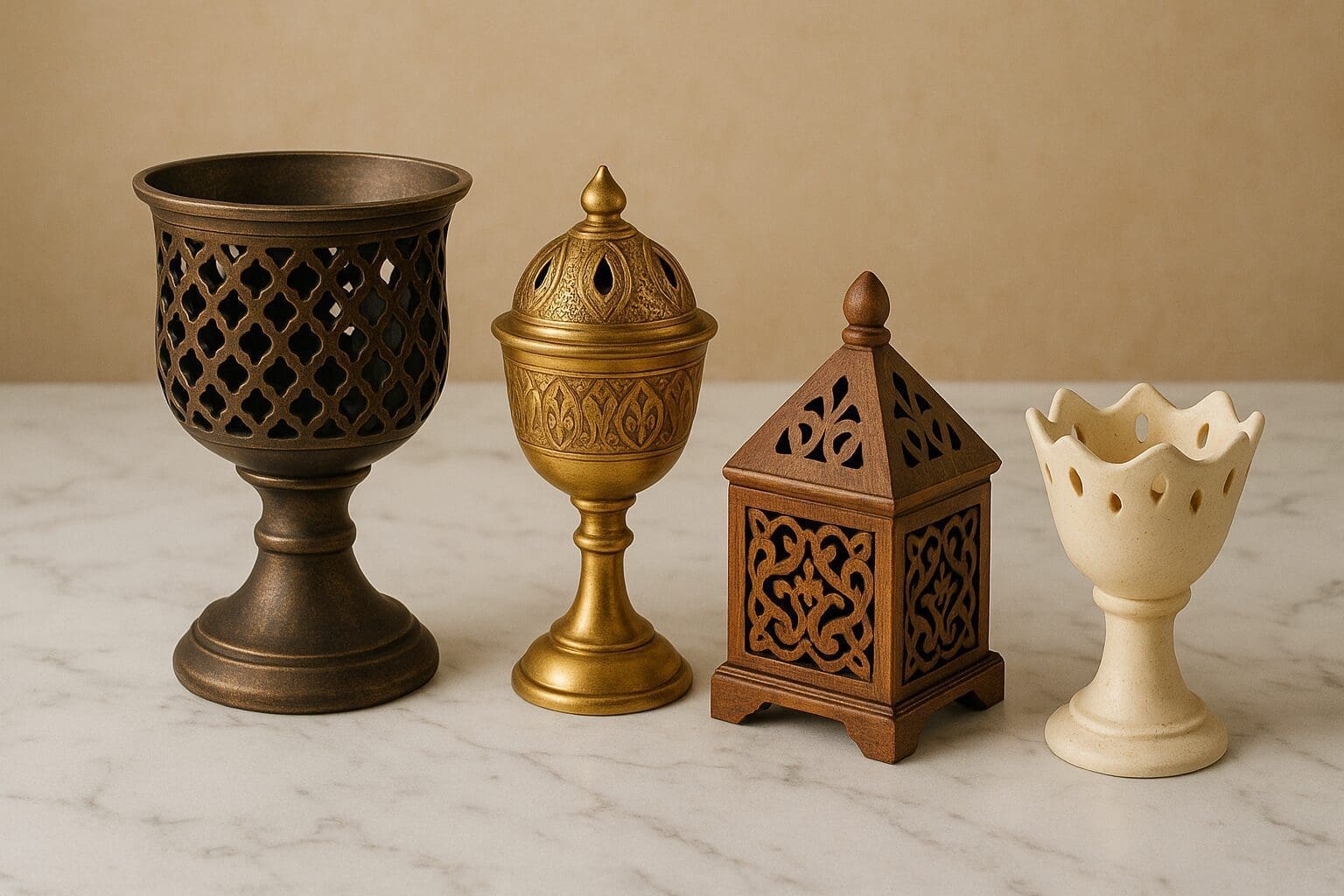
What is a Mabkhara? Discover the Tradition Behind Middle Eastern Incense Burners
F&T Knowledge Library
How a traditional incense burner turns fragrant materials into a shared experience of welcome, memory, and ritual
Sometimes a guest encounters the fragrance of a home before seeing the person who prepared it. That first impression may come from bakhoor warming in a mabkhara: an incense burner used to bring aroma into a room, a gathering, or a personal ritual.
The mabkhara gives fragrance a different role from an oil worn on the skin. One scent belongs to a wearer; the other can shape the atmosphere shared by everyone present. Understanding the burner means looking at both its function and the care behind its use.
A mabkhara holds the heat. The aromatic material provides the scent. The person using them gives the moment its meaning.
What Is a Mabkhara?
A mabkhara is a burner designed for aromatic materials such as bakhoor and agarwood chips. Depending on its design, it uses a compatible heating method to warm the material and release its scent into the surrounding air.
The word names the burner, not the fragrance placed inside it. Bakhoor generally refers to a prepared incense blend, often built around scented wood and other aromatic ingredients. Agarwood is a different material with its own range of woody and resinous aromas. A mabkhara can be part of experiencing either one when the device is suitable for that material.
Burners vary widely in form and material. Some are simple and practical; others are sculptural objects kept where guests can see them. Their appearance has changed across places and generations, while the central idea of preparing a fragrant atmosphere remains familiar.
A Long Tradition of Fragrant Spaces
Incense has a long history in Arabia. Surviving burners from ancient southwestern Arabia show that aromatic materials and the objects used to heat them were valued well before today’s burner designs. Frankincense and myrrh also traveled through historic trade networks linking southern Arabia with other regions.
Today’s mabkhara belongs to living traditions rather than a single unchanged ancient design. Across families and communities, people use incense in different ways. A scent may be associated with receiving guests, preparing for a celebration, marking time at home, or remembering someone who always chose that aroma.
There is no one scent that defines every Middle Eastern home. Family custom, regional preference, the materials available, and the meaning attached to a gathering all influence what someone chooses to warm in a burner.
Three Parts of the Experience
THE BURNER — the vessel and its compatible heat source.
THE MATERIAL — bakhoor, agarwood, or another product explicitly suited to the device.
THE MOMENT — the welcome, gathering, reflection, or everyday routine shaped by the aroma.
The Mabkhara and the Art of Hospitality
Preparing a space before people arrive can be an act of care. A person may choose a warm wood, a soft floral blend, or a familiar family fragrance because it suits the guests and the occasion.
The effect is more than decoration. Fragrance changes how a room is remembered. A familiar bakhoor may call to mind a relative’s home; a distinctive agarwood may become inseparable from a celebration. The burner creates a way to share that sensory experience.
This is also why restraint matters. A welcoming fragrance leaves room for conversation, food, and the comfort of the people present. More smoke does not necessarily create a better atmosphere.
What Can You Use in a Mabkhara?
Start with the material your particular burner is designed to heat. The form of the incense, the heat source, and the manufacturer’s instructions matter as much as the scent profile.
Bakhoor
A prepared incense whose character can range from rich woods and amber-like warmth to rose, musk, or sweeter notes. Composition varies by product.
Agarwood Chips
Pieces of aromatic wood whose scent can express woody, resinous, earthy, or other complex facets, depending on the material.
Other Suitable Aromatics
Some burners accommodate other incense materials. Check the burner’s instructions before using a resin, blend, or oil; a fragrance oil intended for skin is not automatically suitable for heating.
For a deeper comparison of materials, read Bakhoor vs. Oudh.
Traditional and Electric Burners
Traditional charcoal burners and electric burners can offer different experiences. Charcoal creates direct heat and combustion; an electric design uses its own heating element. The amount of aroma and smoke depends on the material, heat setting, and device.
Choose a burner for the way you plan to use it, then follow its specific instructions. Appearance alone cannot tell you whether a burner is compatible with lit charcoal or another heat source. That is especially important for decorative materials: do not place hot coals against a resin body or other surface unless the manufacturer explicitly specifies a suitable heat-resistant insert and method.
If you are choosing a burner for your home, the F&T Mabkhar collection offers a place to compare forms and presentation. Check each product’s heat-source guidance before use.
Make the Ritual Thoughtful and Safe
Aromatic smoke is still smoke. Burning incense can affect indoor air, and burning charcoal produces carbon monoxide. Never burn charcoal indoors, even when a window is open. Do not assume a decorative burner makes indoor charcoal use safe.
For any burner, follow its instructions, use only compatible materials, keep the device on a stable heat-resistant surface, and keep it away from children, pets, fabric, and flammable objects. Do not leave an operating burner unattended. Let every component cool before handling or cleaning it.
An electric burner eliminates the charcoal step but does not automatically eliminate heat, airborne fragrance, or smoke from the material. Use it as directed in a well-ventilated setting and be considerate of anyone sensitive to fragrance or airborne particles.
The Mabkhara Through the Fragrance Intelligence Lens
A fragrance oil can express a person’s presence. A mabkhara extends fragrance into the space around that person. In F&T’s Fragrance Intelligence framework, its role is best understood through the atmosphere someone intends to create.
SACRED RITUAL
Preparation, meaning, reflection, and a deliberate moment of fragrance. This is the strongest connection for a mabkhara used as part of a personal or shared ritual.
CLEAN LUXURY
The care taken in presentation, the shape of the burner, and the restraint of an intentionally prepared room.
SOFT MUSK
The comfort and familiarity of a home whose fragrance becomes part of a guest’s memory.
These identities describe ways to understand the experience, not a fixed classification for every mabkhara or every bakhoor blend. The aromatic material and the intention behind its use still matter.
Frequently Asked Questions
Is a mabkhara the same as bakhoor?
No. The mabkhara is the burner; bakhoor is an aromatic material that may be used with a compatible burner.
Does every mabkhara require charcoal?
No. Electric models have a built-in heating element. Always check the instructions for the specific burner and material.
Can I heat my skin fragrance oil in a mabkhara?
Only if both the oil and the burner explicitly support that use. A fragrance formulated for skin application should not automatically be treated as incense.
Is a mabkhara a meaningful gift?
It can be, particularly for someone who values home fragrance, hospitality, design, or a familiar family scent. Choose a burner that suits the recipient’s space and preferred way of using incense.
Let Fragrance Become Part of the Welcome
The beauty of a mabkhara lies in the relationship between an object, an aromatic material, and the people gathered around it. A carefully chosen scent can make an arrival feel generous, an ordinary evening feel considered, or a meaningful occasion linger in memory.
Begin with the atmosphere you hope to create. Then choose a compatible burner and aromatic material that help express it, with care for everyone who shares the space.
A mabkhara does not simply fill a room with scent. In thoughtful hands, it helps make the room feel prepared for someone.
Explore the Art of Fragrant Hospitality
Discover mabkharas and aromatic materials that can give an intentional fragrance ritual a place in your home.


