Why Your Favorite Fragrance Says More About You Than You Think
Imagine walking into two different homes.
The first is filled with the warm aroma of Oudh rising gently from a mabkhara. Rich woods mingle with amber, soft smoke, and resin, creating an atmosphere that feels grounded, welcoming, and timeless.
The second carries the delicate scent of clean musk, fresh linen, and blooming jasmine. It feels bright, peaceful, polished, and quietly elegant.
Neither fragrance experience is objectively better. Yet most people will instinctively feel more drawn to one than the other.
Why?
The answer has less to do with what is fashionable and far more to do with memory, culture, personality, experience, and intention.
Long before you know the name of a fragrance—or recognize its notes—your mind has already begun interpreting how it makes you feel. It may seem comforting, unfamiliar, sophisticated, nostalgic, energetic, calming, or deeply personal.
That is why choosing a favorite fragrance is rarely random.
In many cases, you are not simply choosing a scent. You are recognizing something familiar about yourself.
Your Favorite Fragrance Is More Than a List of Notes
A fragrance description may tell you that a perfume contains Oudh, musk, rose, amber, sandalwood, saffron, vanilla, or jasmine. Those details are useful, but they cannot fully explain why one fragrance immediately feels right while another leaves you unmoved.
Fragrance is not experienced as a list of ingredients. It is experienced as a complete impression.
Your mind may interpret that impression as:
- warm and familiar;
- deep and commanding;
- soft and intimate;
- clean and refined;
- joyful and expressive;
- reflective and meaningful;
- or mysterious and unfamiliar.
Those reactions are shaped by far more than the fragrance itself. They are also shaped by the person encountering it.
Why Two People Can Love Completely Different Fragrances
Two people can smell the same fragrance and have entirely different reactions.
One person may experience a smoky Oudh as comforting because it reminds them of family gatherings, prayer, travel, or a familiar home. Another person may experience the same aroma as intense because it has no previous emotional context for them.
A powdery musk may feel elegant and reassuring to one wearer, while another finds it too quiet. A sweet amber fragrance may feel joyful and charismatic to one person but overwhelming to someone who prefers cleaner compositions.
The fragrance has not changed.
The relationship between the fragrance and the wearer has.
This is one of the central principles of Fragrance Intelligence: fragrance perception is never only about what is in the bottle. It is also about the memory, identity, expectations, and intentions of the person experiencing it.
The Five Forces That Shape Your Fragrance Preferences
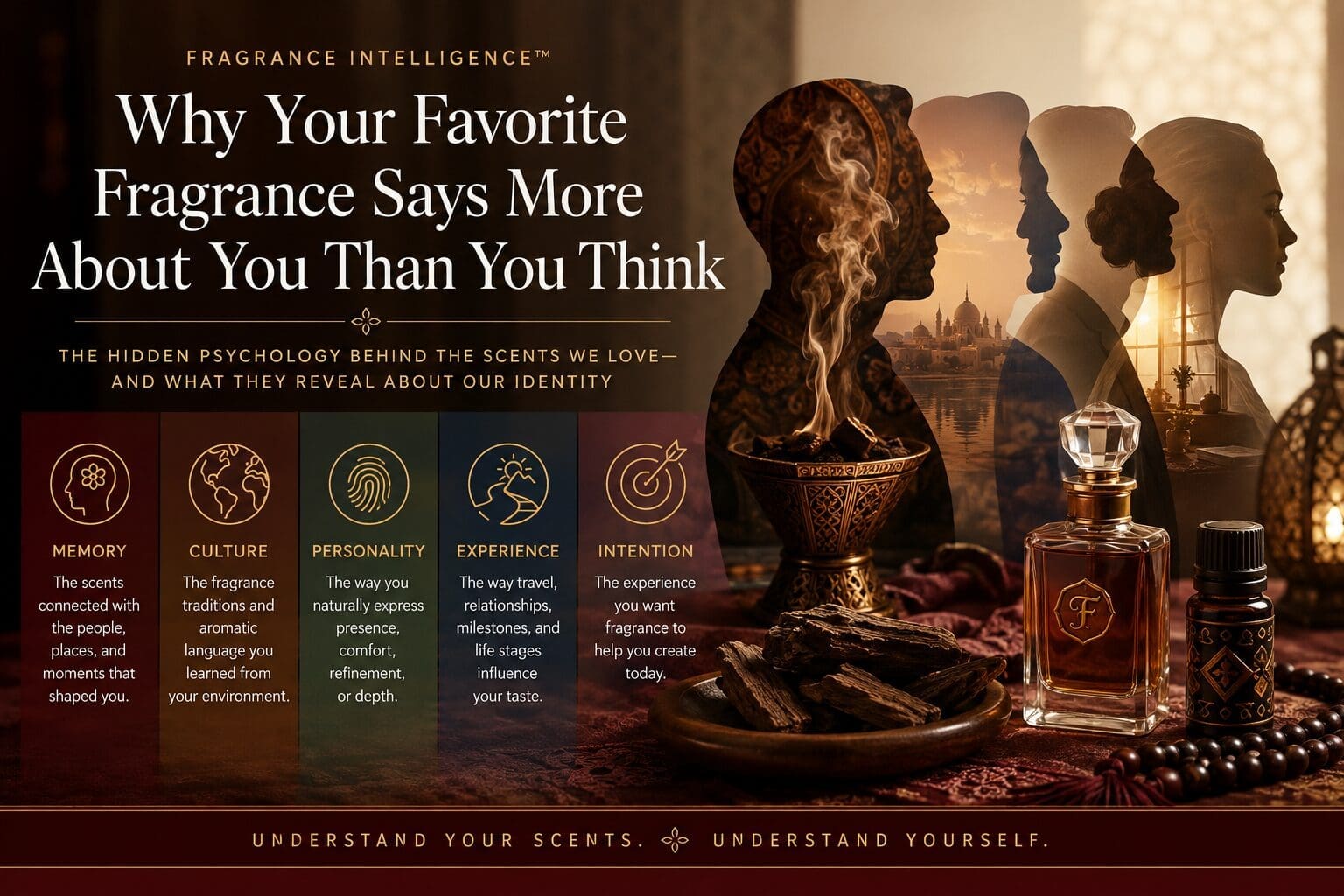
Your fragrance preferences are influenced by many factors, but five forces are especially important:
The Five Forces of Fragrance Preference™
1. Memory — The scents connected with the people, places, and moments that shaped you.
2. Culture — The fragrance traditions and aromatic language you learned from family, community, and environment.
3. Personality — The way you naturally express presence, comfort, refinement, energy, or depth.
4. Experience — The way travel, relationships, milestones, and life stages influence your taste.
5. Intention — The experience you want fragrance to help you create today.
1. Memory: The Fragrances That Stay With You
Fragrance has a remarkable ability to become connected with memory.
You may not remember every detail of a childhood room, a family gathering, or a meaningful journey. Yet a familiar aroma can suddenly bring back the emotional atmosphere of that experience.
It might be:
- the fragrance worn by a parent or grandparent;
- Bakhoor burned before guests arrived;
- soap used in a childhood home;
- fresh rain on warm ground;
- books, wood, tea, spices, flowers, or clean fabric;
- the perfume associated with an important relationship;
- or the scent of a place you once loved.
These experiences become part of your internal fragrance vocabulary. Later, when you encounter similar aromas, your reaction may feel immediate even when you cannot explain why.
This is one reason a fragrance can feel like home before you have consciously identified any of its notes.
2. Culture: Learning the Emotional Language of Fragrance
Fragrance is also cultural.
We learn what aromas mean through the environments in which we grow, the traditions we witness, and the experiences repeated around us.
Someone raised in a home where Bakhoor was burned before guests arrived may associate its aroma with hospitality, preparation, respect, and family. Someone who encounters Bakhoor for the first time may experience only smoke, sweetness, wood, or spice until new memories give the fragrance deeper meaning.
Likewise, Oudh may represent refinement, tradition, personal grooming, spiritual reflection, family, or cultural continuity for one person. To another, it may initially feel unusual because the aroma exists outside their familiar fragrance language.
Neither reaction is wrong.
Culture does not dictate what you must enjoy, but it gives fragrance emotional context.
3. Personality: The Way You Naturally Express Yourself
Fragrance preferences can also reflect how you naturally move through the world.
Some people are drawn to fragrances with unmistakable presence—deep woods, Oudh, amber, smoke, leather, or spice. Others prefer soft musk, gentle florals, clean compositions, or fragrances that remain close to the skin.
Some enjoy joyful sweetness and expressive warmth. Others feel most comfortable in fragrances that communicate calm, polish, serenity, or restraint.
These preferences do not create a complete personality test, and fragrance should never be used to place people into rigid categories. But recurring preferences can reveal patterns in the experiences you value.
You may consistently seek:
- presence;
- comfort;
- elegance;
- energy;
- meaning;
- warmth;
- or individuality.
Your favorite fragrances often reflect one or more of these desires.
4. Experience: How Life Changes What You Love
Your fragrance preferences are not permanently fixed.
The fragrance you loved ten years ago may no longer feel like the fullest expression of who you are today. That does not mean your earlier preference was wrong. It may simply mean that your life—and the person living it—has changed.
Travel can introduce unfamiliar aromatic traditions. A relationship can create new emotional associations. Career changes may influence how you want to present yourself. Marriage, parenthood, grief, celebration, spiritual growth, or a new home can all change what fragrance means to you.
Sometimes you outgrow a fragrance because it remains connected with an earlier version of yourself.
At other times, you return to an old favorite and discover that it still carries a part of your story.
Your fragrance preferences can evolve because you are evolving.
5. Intention: Choosing Fragrance for the Person You Need to Be Today
Perhaps the most overlooked influence on fragrance preference is intention.
Sometimes you choose fragrance because it reflects who you already are. At other times, you choose it because it supports the way you want to feel or the experience you want to create.
- You may choose a polished fragrance before an important meeting.
- You may reach for soft musk when you want comfort.
- You may wear Oudh when you want a stronger sense of presence.
- You may burn Bakhoor before welcoming guests.
- You may choose a familiar fragrance for reflection or prayer.
- You may select something warm and joyful for a celebration.
In these moments, fragrance becomes an intentional companion.
It is no longer something you apply automatically. It becomes part of how you prepare yourself, shape an atmosphere, mark an occasion, or express care for others.
What Your Favorite Fragrance May Be Reflecting
Your favorite fragrance does not provide a complete definition of who you are. It can, however, reflect the qualities and experiences you repeatedly value.
If You Love Deep Woods and Oudh
You may appreciate depth, distinction, craftsmanship, complexity, heritage, or fragrances with unmistakable presence.
This does not necessarily mean you are loud or extroverted. A deep fragrance can also feel grounding, contemplative, or quietly powerful.
If You Love Soft Musk
You may value intimacy, comfort, cleanliness, tenderness, emotional warmth, or fragrances that feel naturally connected with the skin.
If You Love Refined, Clean Fragrances
You may be drawn toward clarity, balance, polish, composure, restraint, or understated elegance.
If You Love Incense, Resins, and Ritual Aromas
You may value meaning, reflection, tradition, atmosphere, serenity, or fragrance experiences connected with ritual and intentional living.
If You Love Sweet, Warm, Expressive Fragrances
You may appreciate warmth, charisma, joy, approachability, creativity, pleasure, or contemporary self-expression.
These descriptions are invitations to reflection—not rules. You can love deep Oudh and clean musk. You can enjoy quiet fragrances during the day and expressive sweetness at night. Human beings are more complex than any single fragrance family.
The Fragrance Identity Framework™
At Fragrance & Things, we organize fragrance discovery around five broad Fragrance Identity families:
Royal Oudh
Depth, distinction, craftsmanship, complexity, and commanding presence.
Soft Musk
Comfort, intimacy, gentleness, familiarity, and emotional warmth.
Clean Luxury
Refinement, clarity, balance, polish, and understated elegance.
Sacred Ritual
Meaning, serenity, reflection, tradition, atmosphere, and intentional living.
Modern Sweet
Warmth, charisma, pleasure, energy, creativity, and contemporary expression.
Your Fragrance Identity is not intended to place you in a permanent box. It helps you recognize patterns, understand your preferences, and begin fragrance discovery with greater direction.
You may have one strong primary identity and a secondary identity that appears in different settings. You may also discover that your intentions influence which side of your fragrance personality becomes most important on a particular day.
Your Favorite Fragrance May Reflect Who You Are—and Who You Are Becoming
Fragrance can reflect the qualities you already possess. It can also support the qualities you are cultivating.
You may choose a fragrance because it feels familiar and authentic. Or you may choose it because it gives you permission to express a side of yourself that does not always appear in everyday life.
A quiet person may enjoy a fragrance with enormous presence. A confident person may prefer something intimate and understated. Someone drawn to tradition may also love playful sweetness.
This is why fragrance identity is not simply a personality label.
It is a conversation between:
- who you are;
- what you remember;
- what you value;
- what you want to feel;
- and who you are becoming.
A Reflection Before You Choose Your Next Fragrance
Before choosing your next fragrance, take a moment to consider the experiences behind your preferences.
- Which fragrances have stayed with you emotionally?
- What aromas remind you of home?
- Which fragrances make you feel most confident?
- Do you prefer fragrance to announce your presence or remain close to you?
- Which scents do you associate with comfort, celebration, faith, family, or travel?
- Has your fragrance taste changed during an important period of your life?
- What do you want your fragrance to help you express today?
Your answers may reveal more than a favorite note. They may reveal the experiences, emotions, and intentions shaping the way you understand fragrance.
Frequently Asked Questions About Fragrance Preference and Identity
Does your favorite fragrance reveal your personality?
Your fragrance preference may reflect qualities, memories, environments, and emotional experiences you value, but it should not be treated as a complete or scientific personality diagnosis. Fragrance Identity is best used as a framework for discovery and reflection.
Why am I attracted to certain smells?
Your attraction to particular aromas can be shaped by memory, familiarity, cultural learning, personal experience, emotional association, and the type of experience you want fragrance to create.
Why do my fragrance preferences change?
Preferences can change as you encounter new fragrances and move through different environments, relationships, responsibilities, and stages of life. A changing preference can reflect a changing relationship with identity and experience.
Can culture influence fragrance preference?
Yes. Cultural traditions and repeated exposure can influence which aromas feel familiar, comforting, meaningful, luxurious, celebratory, or appropriate for particular settings.
Can I have more than one Fragrance Identity?
Yes. Many people have a strong primary identity along with one or more secondary preferences. Your preferred identity may also shift according to your intention, environment, season, or occasion.
What if I enjoy fragrances from every family?
That is completely natural. The purpose of the framework is not to limit what you wear. It helps identify recurring patterns while leaving room for exploration, evolution, and variety.
How can I discover my Fragrance Identity?
You can begin by reflecting on the aromas, environments, emotions, and experiences you repeatedly enjoy. The Fragrance & Things Fragrance Identity Quiz provides a guided way to identify your strongest identity families.
Continue Your Journey
Discover What Your Fragrance Preferences Reveal
Your favorite fragrance may reflect memory, culture, personality, experience, and intention. Continue exploring the forces that shape your relationship with scent.
Discover Your Fragrance Identity
Explore the fragrance identity families that best reflect your preferences, personality, emotional connections, and the experiences you want fragrance to create.
Take the Fragrance Identity Quiz →Continue Exploring
The Science of Fragrance: How Perfume Is Created and Experienced →
How to Choose a Middle Eastern Fragrance That Fits You →
Types of Oudh Explained: Origins, Profiles, and Interpretations →
Explore Fragrance Oils
Put your discoveries into practice by exploring fragrance oils connected with different identities, intentions, and aromatic experiences.
Explore Fragrance Oils →Your favorite fragrance may begin with an aroma, but its meaning is shaped by everything you bring to it: the memories you carry, the culture that formed you, the personality you express, the experiences that changed you, and the intentions guiding you today. Understanding those influences does not remove the mystery of fragrance. It makes the experience more personal—and gives you a deeper appreciation for why certain scents feel unmistakably like your own.