How to Choose a Middle Eastern Fragrance: Find the Scent That Fits You
Choosing a Middle Eastern fragrance can feel overwhelming at first. Oudh, musk, rose, amber, sandalwood, spices, perfume oils, attars, bakhoor—the vocabulary alone can make it difficult to know where to begin.
But finding the right fragrance does not require memorizing every note or understanding every tradition before you start. A better approach is to begin with something more personal: the experience you want fragrance to create.
Do you want a fragrance that feels polished and refined? Warm and comforting? Deep and commanding? Reflective and meaningful? Sweet and charismatic? The answer tells you far more about where to begin than simply choosing whichever fragrance is most popular.
At Fragrance & Things, this is the foundation of Fragrance Intelligence: start with the person, the intention, and the experience—then explore the fragrance.
This guide will help you understand the major fragrance materials and formats, identify the experience you want, explore your Fragrance Identity, and make a more confident choice whether you are shopping in person or discovering fragrance online.
1. Start With the Experience You Want
Before thinking about Oudh, musk, rose, or any individual note, ask a more useful question:
What do I want this fragrance to help me express or experience?
Your answer might point toward one or more Fragrance Intentions.
- Presence: You want a fragrance that feels distinctive and memorable.
- Confidence: You want something polished, composed, and appropriate for important moments.
- Comfort: You prefer fragrances that feel familiar, gentle, warm, or reassuring.
- Reflection: You want aroma to accompany prayer, reading, journaling, contemplation, or quiet time.
- Hospitality: You want fragrance to shape the atmosphere of your home or gathering space.
- Celebration: You want something associated with special occasions, milestones, family gatherings, or festivities.
These intentions are not rigid categories. The same fragrance may serve more than one purpose, and your preferences may change depending on the occasion. The goal is simply to begin choosing with purpose instead of selecting fragrance at random.
2. Understand the Foundations of Middle Eastern Fragrance
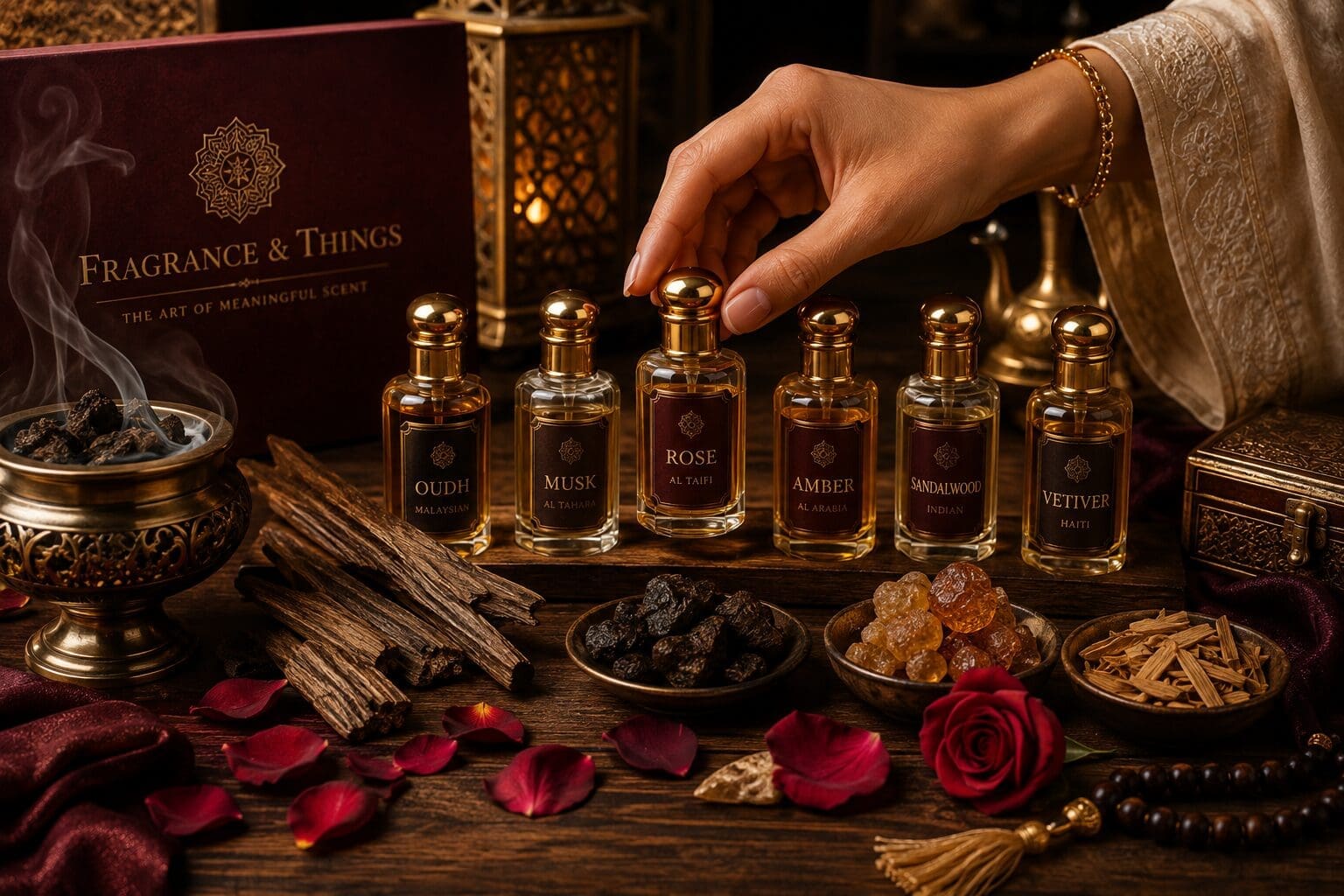
Middle Eastern perfumery contains enormous variety, but several aromatic materials and styles appear frequently. Understanding their general character gives you useful vocabulary when reading fragrance descriptions.
Oudh
Oudh is associated with fragrance derived from resin-rich agarwood. Depending on its origin, preparation, and composition, it may feel woody, smoky, earthy, leathery, resinous, sweet, balsamic, spicy, or animalic.
Oudh is an excellent area to explore if you appreciate depth, complexity, and fragrances with strong character, but it is not a requirement for enjoying Middle Eastern perfumery.
Musk
Musk can take many forms in modern fragrance. A musk composition may feel clean and airy, warm and skin-like, soft and powdery, sensual, or deeply grounding depending on how it is constructed.
People who prefer understated intimacy, comfort, or a fragrance that sits closer to the body often find musk-based compositions appealing.
Rose
Rose occupies an important place in many Middle Eastern fragrance compositions. It can feel fresh, velvety, rich, elegant, green, sweet, or deeply romantic depending on the variety and surrounding notes.
Rose is especially versatile because it can soften darker woods, complement musk, or create striking contrast with Oudh.
Amber Accords
In modern perfumery, “amber” usually describes a warm fragrance accord rather than a single raw material. Amber-style compositions often combine sweet, resinous, balsamic, vanilla-like, spicy, or woody elements to create warmth and depth.
Sandalwood
Sandalwood is prized for its creamy, smooth, woody character. It can create softness beneath stronger ingredients and often contributes warmth and balance to a composition.
Spices
Saffron, cardamom, cinnamon, clove, and other spices can contribute warmth, brightness, dryness, sweetness, or aromatic complexity. Their effect depends heavily on the complete fragrance composition.
Where Does Bakhoor Fit?
Bakhoor is not a fragrance note. It is a prepared incense blend intended primarily for environmental fragrance. Depending on the formula, Bakhoor may contain woods, fragrance oils, resins, spices, florals, musk-style accords, agarwood, and other aromatic materials.
If your goal is to fragrance your home, clothing environment, or gathering space rather than simply wear fragrance on your skin, Bakhoor may be an important part of your discovery journey.
3. Discover Your Fragrance Identity
If choosing from dozens of fragrances feels overwhelming, start with the person rather than the bottle.
The Fragrance & Things Fragrance Identity framework organizes fragrance discovery around five broad identity families. These identities are not rules and they do not limit what you can wear. They provide a starting point for understanding which fragrance experiences may naturally resonate with you.
Royal Oudh
Royal Oudh reflects depth, authority, distinction, craftsmanship, and presence. You may naturally appreciate woody, resinous, complex, powerful, or sophisticated fragrance profiles.
Soft Musk
Soft Musk reflects comfort, intimacy, emotional warmth, gentleness, and familiarity. Clean musks, powdery compositions, soft florals, and comforting fragrances may feel especially natural.
Clean Luxury
Clean Luxury reflects refinement, polish, clarity, balance, and understated elegance. You may prefer fragrances that feel sophisticated without becoming overwhelming.
Sacred Ritual
Sacred Ritual reflects meaning, tradition, reflection, serenity, and intentional living. Musks, woods, resins, incense-like compositions, and fragrances connected with ritual may feel particularly resonant.
Modern Sweet
Modern Sweet reflects charisma, warmth, contemporary expression, energy, and approachability. Sweet musks, vanilla, amber-style accords, fruits, florals, and modern gourmand elements may naturally appeal.
Most people are not limited to one identity. You may have a strong primary identity while also enjoying fragrances associated with another family. The purpose is to create direction—not boundaries.
4. Consider Where You Will Wear or Experience the Fragrance
Context matters. A fragrance can be beautiful and still feel wrong for the environment in which you are wearing it. Think about how much presence you want the fragrance to have and who will share the space with you.
Everyday Wear
For everyday fragrance, look for something that fits naturally into your normal routine. That could mean a clean musk, a balanced woody fragrance, a soft floral, a gentle sweet composition, or even a deeper Oudh if that genuinely reflects your style.
Professional Settings
Consider both the fragrance and its projection. In shared environments, a refined fragrance worn with restraint may communicate more effectively than something designed to dominate the room.
Formal or Evening Occasions
Evenings, weddings, celebrations, and formal gatherings often provide room for richer compositions, including deeper woods, Oudh, amber-style accords, rose, spices, and more expressive musks. These are possibilities rather than requirements.
Reflection and Ritual
For moments of reading, prayer, contemplation, or quiet personal ritual, consider fragrances that already hold meaning for you or help define the atmosphere you want to create.
Hospitality and Home
When your intention is to fragrance a shared space, Bakhoor, agarwood, and other home-fragrance traditions may be more appropriate than choosing only a personal perfume.
5. Choose the Right Fragrance Format
The fragrance itself is only part of the decision. The format determines how you experience it.
Perfume Oil or Attar
Perfume oils are applied directly to the skin and are often appreciated for their intimacy, concentration, and controlled application. They can be an excellent choice if you prefer fragrance closer to the body rather than broad spray diffusion.
Eau de Parfum
Eau de Parfum is generally an alcohol-based spray format that disperses fragrance more broadly. It can be familiar and convenient for people accustomed to modern spray perfumery.
Oudh Oil
Oudh oil offers a more specialized concentrated fragrance experience. Natural Oudh can vary dramatically by provenance, resin, distillation, and aging, while Oudh compositions can interpret the material in many different ways.
Bakhoor
Bakhoor is intended primarily for the surrounding environment. It is heated or burned using a suitable incense burner and can fragrance rooms, gathering spaces, and—when handled carefully—the atmosphere around clothing.
Agarwood Chips
Resin-rich agarwood can be heated directly to experience the aromatic wood itself. This provides a different experience from either composed Bakhoor or distilled Oudh oil.
6. Understand Fragrance Notes Without Becoming Trapped by Them
Fragrance notes are useful because they give you a vocabulary for describing a composition. But a note list is not the fragrance itself.
Two perfumes can both contain rose, musk, Oudh, or sandalwood and still smell dramatically different because the proportions, supporting materials, concentration, structure, and overall composition are different.
Instead of asking only, “Does this contain a note I like?” ask:
- Is that note dominant or supporting?
- Is the fragrance described as soft, bold, dry, sweet, smoky, clean, or resinous?
- What notes surround it?
- What is the overall emotional character of the fragrance?
- Does the description match the experience I want?
This is one of the reasons fragrance selection becomes easier when you combine note knowledge with Fragrance Identity, intention, and context.
7. Test the Fragrance Properly
If you have the opportunity to test a fragrance before purchasing it, give yourself enough time to experience more than the opening.
A fragrance can change considerably after application. The first few minutes may emphasize brighter or more volatile materials, while deeper heart and base notes become more noticeable as the fragrance develops.
- Test on skin when possible, not only on a blotter.
- Apply a modest amount rather than overloading your senses.
- Wait several hours before making a final judgment.
- Notice how the fragrance changes from opening to drydown.
- Consider whether you still enjoy it after the strongest first impression fades.
If you want a deeper explanation of why fragrances evolve over time, see The Science of Fragrance: How Perfume Is Created, Perceived, and Experienced.
8. Start Small When You Are Still Learning
You do not need to commit to the largest available quantity when you are still exploring your preferences. Samples, smaller bottles, and traditional fragrance-oil sizes can give you time to understand how often you reach for a fragrance before purchasing more.
You may also encounter the traditional term tola when shopping for perfume oils. A standardized tola is a unit of mass equal to approximately 11.66 grams. In fragrance commerce, however, a full-tola bottle is also commonly associated with approximately 12 mL as a packaging convention.
If the terminology is unfamiliar, see What Is a Tola? Understanding the Traditional Fragrance Measurement.
9. Give the Fragrance Time to Become Familiar
Not every fragrance reveals its value immediately. Some compositions are instantly familiar, while others require several wearings before their structure becomes easier to understand.
This is especially true with deeper Oudh, resinous, musky, spicy, or incense-like fragrances if your previous experience has primarily been with lighter contemporary perfumes.
A first impression is useful, but it does not always need to become a final verdict. As your Fragrance Memory grows, aromas that once felt unfamiliar may become increasingly meaningful—or you may confirm that they simply are not for you. Both outcomes are valuable.
10. Explore Fragrance Layering
Layering allows you to combine fragrances and create an experience that feels more personal. Middle Eastern fragrance traditions offer especially rich possibilities because perfume oils, musks, florals, woods, Oudh, and other compositions can interact in many different ways.
If you are new to layering, keep the process simple:
- Begin with two fragrances rather than several.
- Learn how each fragrance smells on its own first.
- Use modest amounts so one does not automatically overwhelm the other.
- Experiment with contrasting and complementary profiles.
- Keep track of combinations you enjoy so you can recreate them later.
For example, a deeper Oudh may be softened with rose or musk, while a clean musk can gain warmth from a subtle woody or amber-style fragrance. There is no universal formula—the goal is to discover combinations that feel coherent to you.
11. How to Choose a Middle Eastern Fragrance Online
Buying fragrance online requires a different kind of confidence because you cannot rely on your nose at the moment of purchase. Instead, you build a picture of the fragrance from several signals.
When evaluating a fragrance online, look for:
- Primary fragrance family: Is it musky, woody, floral, sweet, resinous, fresh, or something else?
- Dominant notes: Which materials appear central rather than merely listed?
- Intensity: Does the description suggest light, moderate, strong, or very strong presence?
- Emotional character: Does it feel comforting, elegant, mysterious, sacred, confident, joyful, or luxurious?
- Use case: Is it positioned for daily wear, office use, formal occasions, reflection, gatherings, or layering?
- Format: Is it a perfume oil, Oudh oil, spray perfume, Bakhoor, or another aromatic form?
- Your existing preferences: Which fragrances have you already enjoyed, and what do they have in common?
Reviews can provide additional perspective, but remember that fragrance perception is personal. A review tells you how someone else experienced the fragrance; it does not guarantee that your experience will be identical.
12. Use the Fragrance Intelligence Method
When too many options begin to feel overwhelming, reduce the decision to six questions:
1. Identity — Who are you?
Which fragrance identity or combination of identities feels closest to your natural preferences?
2. Intention — What do you want fragrance to do?
Are you seeking presence, comfort, confidence, reflection, hospitality, or celebration?
3. Profile — What aromatic character attracts you?
Do you naturally respond to musk, woods, Oudh, florals, amber-style warmth, sweetness, spices, or cleaner compositions?
4. Environment — Where will you experience it?
Daily life, work, formal occasions, home, reflection, or special gatherings?
5. Format — How do you want to experience it?
Perfume oil, spray perfume, Oudh oil, Bakhoor, or agarwood?
6. Experience — How does it actually feel to you?
Once everything else is considered, your own experience remains the final decision.
This method does not guarantee that every fragrance will become a favorite. It does something more useful: it gives you a repeatable way to make better-informed choices instead of guessing.
Frequently Asked Questions About Choosing Middle Eastern Fragrance
How do I choose a Middle Eastern fragrance?
Start with the experience you want, then consider your fragrance identity, preferred aromatic profile, where you will wear it, and the format that best fits your lifestyle. Notes are useful, but they should be interpreted within the complete fragrance rather than considered alone.
What is the best Middle Eastern fragrance for beginners?
There is no universal beginner fragrance. A softer musk, balanced woody fragrance, gentle floral, or approachable Oudh blend may work well depending on your existing preferences. Start from scents you already enjoy rather than assuming every beginner should choose the same profile.
Do I need to like Oudh to enjoy Middle Eastern fragrance?
No. Middle Eastern perfumery includes musk, rose, amber-style compositions, florals, spices, sandalwood, sweet fragrances, fresh profiles, and many other styles. Oudh is important, but it is only one part of a much broader fragrance tradition.
Should I choose perfume oil or spray perfume?
Choose based on how you like fragrance to behave. Perfume oils often provide controlled, close application, while spray perfumes generally create broader diffusion. Neither format is inherently better.
How do I choose a fragrance online without smelling it first?
Use the fragrance family, dominant notes, intensity, emotional character, intended use, format, and your previous preferences together. Avoid making the decision from one note or one review alone.
What fragrance is best for everyday wear?
The best everyday fragrance is one that fits comfortably into your routine, environment, and desired level of presence. It can be light or deep, simple or complex—the important factor is whether it feels natural enough that you genuinely want to wear it regularly.
Can men and women wear the same Middle Eastern fragrances?
Yes. Many traditional fragrance materials such as Oudh, musk, rose, amber-style accords, woods, and spices are enjoyed across gender categories. Personal preference is often more useful than relying only on marketing labels.
How do I know my Fragrance Identity?
Your Fragrance Identity reflects the fragrance experiences that align with your personality, preferences, motivations, and emotional responses. The Fragrance & Things Identity Quiz provides a structured starting point for discovering your primary and secondary identity families.
Should I always test perfume on my skin?
Testing on skin can provide a more realistic impression of how a personal fragrance develops on you. A blotter remains useful for initial comparison, but skin testing allows you to experience the fragrance over time in the context in which you are likely to wear it.
What should I try first if I am new to fragrance oils?
Begin with a smaller quantity and a profile connected to fragrances you already enjoy. If you prefer clean and soft scents, start there rather than immediately choosing the darkest Oudh available simply because it is traditional.
Continue Your Journey
Turn Fragrance Choice Into Personal Discovery
The right fragrance is not simply the one everyone else loves. It is the one that makes sense for your identity, intention, environment, and experience.
Discover Your Fragrance Identity
Start with yourself instead of the bottle. Discover the fragrance identity families that best reflect your personality, preferences, and the experiences you want fragrance to create.
Take the Fragrance Identity Quiz →Continue Exploring
The Science of Fragrance: How Perfume Is Created and Experienced →
Bakhoor vs. Oudh: What’s the Difference? →
Types of Oudh Explained: Origins, Profiles, and Modern Interpretations →
Explore Fragrance Oils
Now that you have a clearer framework for choosing, explore Middle Eastern fragrance oils with greater confidence and look for the profiles that align with your identity and intentions.
Explore Fragrance Oils →Choosing a Middle Eastern fragrance becomes much easier when you stop searching for a universally perfect scent and begin looking for the fragrance that makes sense for you. Learn the materials, understand the format, consider the environment, give the fragrance time, and pay attention to your own response. The goal is not merely to find something that smells beautiful—it is to discover fragrance that becomes a meaningful extension of how you choose to move through the world.