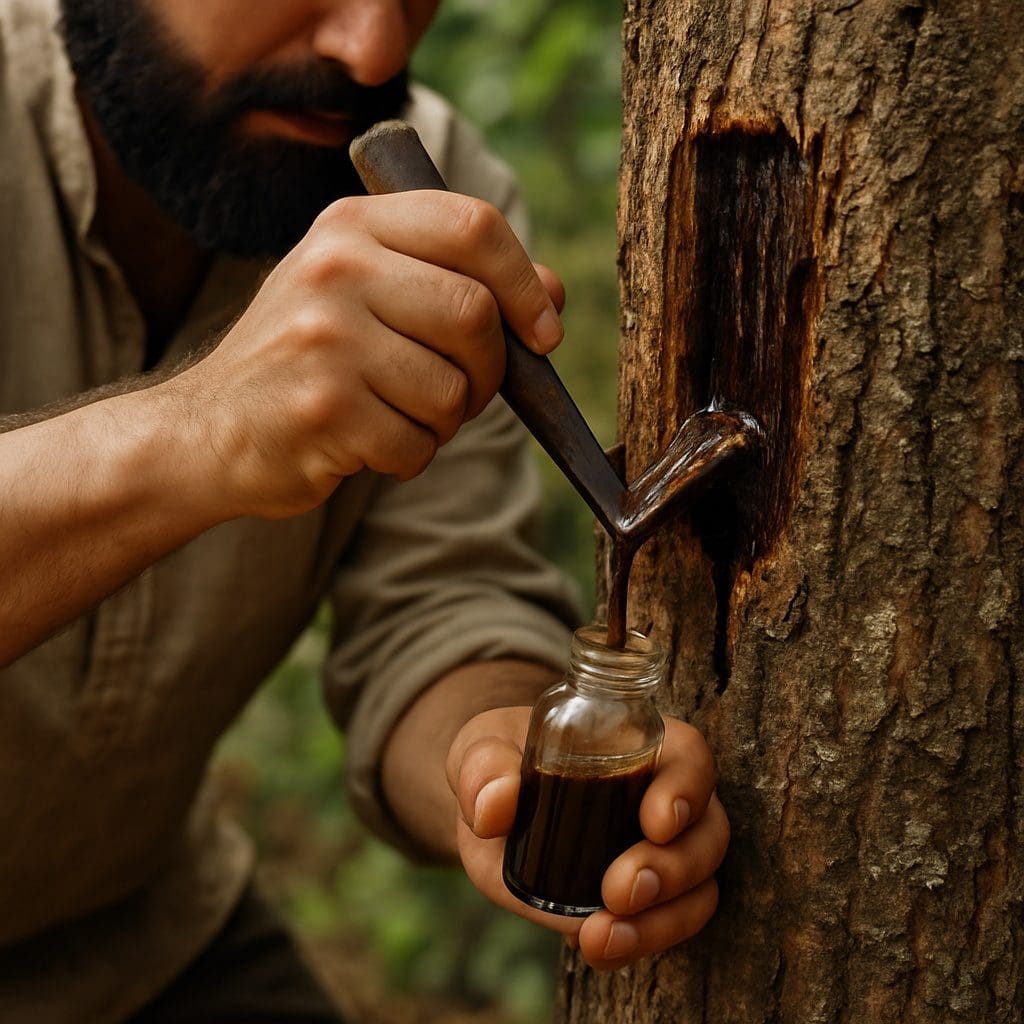
What Is a Tola? Understanding the Traditional Fragrance Measurement
If you explore traditional fragrance oils, attars, or Oudh for long enough, you may eventually encounter an unfamiliar measurement: the tola. A fragrance seller might offer a quarter tola, half tola, or full tola instead of describing the quantity only in milliliters.
For someone accustomed to seeing fragrance bottles labeled 3 mL, 6 mL, 10 mL, or 12 mL, the terminology can be confusing. How much is a tola? Is it a measurement of liquid volume? And why does this traditional unit continue to appear in fragrance commerce?
The answer connects fragrance with a much older history of measurement and trade. The tola is traditionally a unit of mass equal to approximately 11.66 grams. Although its origins are South Asian rather than specifically Middle Eastern, the term also became familiar within parts of the fragrance trade, particularly around attars, Oudh oils, and other concentrated perfume oils.
Understanding that distinction makes the tola much easier to recognize—and prevents one of the most common misunderstandings surrounding this traditional measurement.
What Is a Tola?
A tola is a traditional South Asian unit of mass. In its standardized form, one tola equals approximately 11.66 grams, or 3/8 of a troy ounce.
The unit has a long association with commerce and was historically used for weighing valuable materials, particularly precious metals such as gold and silver. Over time, the word also became familiar in other forms of trade, including traditional fragrance-oil commerce.
This history is important because a tola was not originally invented as a perfume measurement. Fragrance adopted an existing commercial unit whose meaning was already understood by generations of merchants and customers.
Where Did the Tola Come From?
The history of the tola is rooted in the Indian subcontinent. The word is associated with the Sanskrit term tola, referring to a weight or balance, and versions of the measurement existed long before modern metric units became standard.
During the nineteenth century, the tola was formally standardized within the British Indian system of weights. The standardized tola was defined as 180 grains, equivalent to approximately 11.6638 grams and exactly three-eighths of a troy ounce.
Its connection with valuable commodities helped the term survive even as kilograms and grams became the dominant measurement system. The tola remains especially recognizable in parts of South Asia, where it continues to appear in precious-metal commerce and other traditional contexts.
How Much Is One Tola?
As a measurement of mass, the basic conversion is straightforward:
1 Tola = 11.6638 grams
1 Tola = 3/8 troy ounce
The confusion begins when the term appears on perfume-oil bottles, where you may also see one tola associated with a bottle holding approximately 12 mL.
Is One Tola the Same as 12 mL?
Not exactly. This is one of the most useful distinctions to understand when shopping for traditional fragrance oils.
A gram measures mass, while a milliliter measures volume. Converting directly between the two requires knowing the density of the substance being measured. Because fragrance oils can have different densities, 11.66 grams of one oil will not necessarily occupy exactly the same volume as 11.66 grams of another.
In fragrance commerce, however, approximately 12 mL is commonly associated with a full-tola bottle size. Similarly, approximately 6 mL may be described as half a tola, while approximately 3 mL may be described as a quarter tola.
Those milliliter amounts are best understood as fragrance-trade packaging conventions, not exact mathematical conversions of the traditional unit of mass.
Common Tola Sizes in Fragrance
When shopping for attars, Oudh oils, or other concentrated fragrance oils, you may encounter several traditional size descriptions:
- Quarter Tola: traditionally one-quarter of the full mass measurement; in fragrance packaging, often associated with approximately 3 mL.
- Half Tola: traditionally one-half of a tola; in fragrance packaging, often associated with approximately 6 mL.
- One Tola: 11.6638 grams as a unit of mass; in fragrance packaging, commonly associated with approximately 12 mL.
- Multiple Tolas: larger quantities may also be described using multiples of the traditional unit.
Because sellers may use the terminology somewhat differently, the most reliable practice is simple: check the actual stated weight or volume of the fragrance rather than relying on the word “tola” alone.
Why Is the Tola Used for Perfume Oils?
The continued use of the tola in fragrance makes more sense when viewed through the history of trade. Concentrated perfume oils, attars, Oudh, musk compositions, and other precious aromatics were historically traded in regions where traditional systems of measurement were already part of commercial life.
As fragrance traditions moved through interconnected South Asian, Persian, Arabian, and other markets, terminology traveled with the goods themselves. The tola therefore became familiar within portions of the perfume-oil trade even though the measurement originated in South Asia.
Today, seeing the term on a fragrance bottle can serve as a reminder of that older commercial vocabulary—a connection between contemporary fragrance appreciation and the historical markets through which aromatic materials have circulated for generations.
Tola vs. Milliliters: What Is the Difference?
When purchasing fragrance, understanding the difference between a tola and a milliliter helps you compare products more accurately.
A tola traditionally measures mass. A milliliter measures volume. Although fragrance sellers may use familiar approximations such as 12 mL for a full tola bottle, the two units measure different properties and should not be treated as mathematically interchangeable.
For everyday fragrance shopping, the easiest approach is to look for the quantity stated directly on the product. If a fragrance is described as “one tola” and also labeled 12 mL, the 12 mL tells you the bottle’s stated liquid volume, while “tola” reflects the traditional sizing terminology used by that seller.
Does Tola Mean the Fragrance Is High Quality?
No. A tola describes quantity or a traditional bottle-size convention; it does not establish the quality of the fragrance inside the bottle.
The quality of an Oudh oil, attar, or other perfume oil depends on factors such as its ingredients, formulation, concentration, craftsmanship, sourcing, storage, and authenticity. Two fragrances offered in identical tola-size bottles can differ dramatically in character and quality.
This distinction is especially useful when encountering traditional fragrance terminology for the first time. Words associated with heritage can provide meaningful cultural context, but they should not replace careful evaluation of the fragrance itself.
The Tola in Oudh and Attar Culture
The tola is particularly familiar to people who explore Oudh oils, attars, mukhallats, musk compositions, and other concentrated perfume oils. These fragrance traditions developed through regions connected by centuries of commerce, migration, craftsmanship, and cultural exchange.
Because concentrated oils are generally applied in small amounts, relatively small bottles can provide many applications. Traditional size terminology therefore became part of the vocabulary surrounding the experience of buying, collecting, gifting, and wearing these fragrances.
For a new fragrance enthusiast, learning what “quarter tola” or “one tola” means is therefore similar to learning terms such as Oudh, attar, bakhoor, or mabkhara. Each term provides another piece of the cultural and practical vocabulary surrounding traditional fragrance.
Tola Bottles, Presentation, and Gifting
Traditional perfume oils are often presented in decorative bottles that make the fragrance experience visual as well as aromatic. Depending on the perfumery and region, bottles may feature intricate glasswork, metallic detailing, ornamental caps, or presentation boxes.
Fragrance itself also carries a long tradition of gifting across many Middle Eastern and South Asian communities. Oudh oils, attars, bakhoor, and other aromatics may be shared during celebrations, family gatherings, weddings, religious holidays, or simply as gestures of hospitality and appreciation.
The significance of such a gift comes from the fragrance, presentation, relationship, and occasion—not from the tola measurement alone. Understanding that distinction allows us to appreciate tradition without assigning meaning to the unit that it does not inherently possess.
Why Does the Tola Still Matter?
Modern fragrance commerce increasingly uses milliliters and other metric measurements, yet the word “tola” continues to appear because traditional vocabulary has a remarkable ability to survive alongside newer systems.
For experienced fragrance enthusiasts, the term may feel immediately familiar. For newcomers, learning it provides useful context for understanding product sizes and comparing traditional perfume oils. For the Knowledge Library, it also offers a small but revealing example of how fragrance preserves traces of the trade networks and cultures through which it developed.
The tola therefore matters not because it proves that a fragrance is rare or luxurious, but because understanding the term makes you a more informed fragrance buyer and a more knowledgeable participant in the traditions surrounding Oudh and attar.
The Fragrance Intelligence Perspective
Fragrance Intelligence is not only about discovering which aromas appeal to you. It also involves developing the knowledge needed to understand what you are experiencing, comparing, and purchasing.
Learning traditional fragrance vocabulary strengthens that understanding. Knowing the difference between a measurement, a fragrance material, a preparation, and a cultural practice helps you evaluate fragrance with greater confidence instead of relying on unfamiliar terminology as an indicator of quality.
In that sense, understanding the tola is a small lesson in fragrance discernment: know what a term tells you—and equally important, know what it does not.
Frequently Asked Questions About the Tola
How many grams are in one tola?
One standardized tola equals approximately 11.6638 grams.
How many milliliters are in one tola of perfume?
There is no universal exact conversion because a tola measures mass while a milliliter measures volume. In fragrance commerce, however, a full-tola bottle is commonly associated with approximately 12 mL of perfume oil.
Is 12 mL exactly one tola?
No. Approximately 12 mL is commonly used as a fragrance bottle-size convention for one tola, but it is not an exact conversion of 11.6638 grams. An exact mass-to-volume conversion depends on the density of the liquid.
What is half a tola?
Half a standardized tola is approximately 5.83 grams. In perfume-oil packaging, “half tola” is also commonly associated with an approximately 6 mL bottle.
What is a quarter tola?
One-quarter of a standardized tola is approximately 2.92 grams. In fragrance packaging, “quarter tola” is commonly associated with an approximately 3 mL bottle.
Is the tola used for Oudh?
Yes. Tola terminology can be encountered when purchasing Oudh oils, attars, musk compositions, mukhallats, and other concentrated perfume oils, although modern sellers may also state the quantity directly in milliliters.
Does a tola bottle mean the perfume is high quality?
No. Tola describes a traditional measurement or fragrance packaging convention. It does not guarantee concentration, authenticity, natural ingredients, craftsmanship, or fragrance quality.
Continue Your Journey
Turn Knowledge Into Fragrance Confidence
Every article in the Fragrance & Things Knowledge Library is designed to help you discover, understand, and experience the world of Middle Eastern fragrance with confidence.
Discover Yourself
Understanding fragrance terminology helps you shop with confidence. Understanding your Fragrance Identity helps you discover which fragrance experiences may resonate most naturally with you.
Take the Fragrance Identity Quiz →Continue Exploring
What Is Oudh? The Story Behind the World’s Most Precious Fragrance →
The History of Oudh: From Ancient Agarwood to Modern Perfumery →
What Is a Mabkhara? Understanding the Traditional Incense Burner →
The Science of Fragrance: How Perfume Is Created and Experienced →
Experience Oudh
Now that you understand one of the traditional measurements associated with Oudh and perfume oils, continue your exploration through fragrances connected to this enduring tradition.
Explore the Oudh Collection →The tola may be a small unit of measurement, but understanding it opens a larger window into the vocabulary of traditional fragrance. Once you know what the term means—and what it does not mean—you can explore Oudh, attars, and perfume oils with greater clarity, confidence, and appreciation for the traditions surrounding them.