
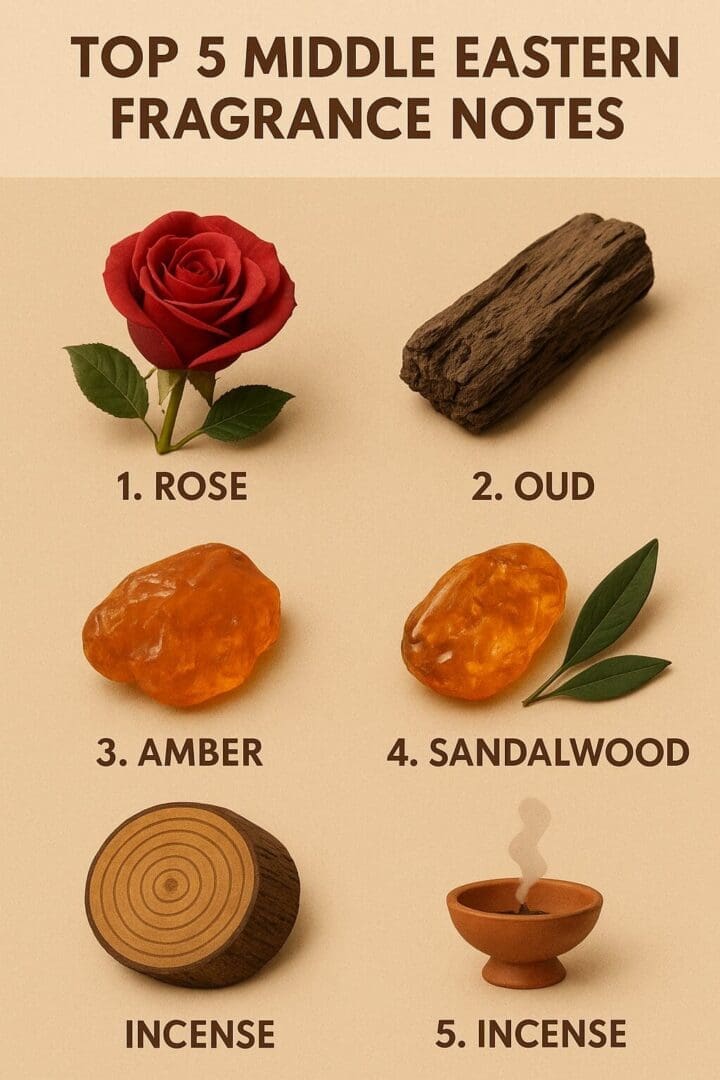
5 Middle Eastern Fragrance Notes Worth Knowing
Rose, Oudh, Amber, Sandalwood & Incense—and How They Change in a Fragrance
Fragrance descriptions often begin with notes.
Rose. Oudh. Amber. Sandalwood. Incense.
These names can be helpful, but they are only the beginning of understanding a fragrance.
A note does not tell you exactly how a fragrance will feel, how strong it will be, what emotional role it may create, or which Fragrance Identity™ it will align with.
A fragrance note is an ingredient or aromatic idea. The fragrance experience comes from the way the entire composition works together.
That distinction is especially important in Middle Eastern perfumery, where familiar materials can be combined in ways that feel rich, soft, clean, reflective, sweet, traditional, or unexpectedly modern.
This guide explores five notes that appear frequently across Middle Eastern fragrance and explains not only what they are known for, but also how their character can change depending on what surrounds them.
Why Fragrance Notes Matter—And Why They Are Not the Whole Story
Fragrance notes help us describe what we perceive inside a composition.
They can point toward florals, woods, resins, spices, musks, citrus, sweetness, smoke, or other aromatic directions.
But reading a note list is a little like reading a list of ingredients in a meal.
You may know what is present, but you still do not know exactly how the final experience will feel.
Rose can feel fresh or dense.
Oudh can feel commanding or quiet.
Amber can feel warm and soft or dark and resinous.
Sandalwood can feel creamy, dry, polished, or meditative.
Incense can feel sacred, atmospheric, smoky, or elegant.
The note matters.
The composition matters more.
1. Rose — More Than Simply “Floral”
Rose is one of the most recognizable fragrance materials in the world, but describing a fragrance as “rose” tells you surprisingly little about how it will behave.
Depending on the composition, rose can feel:
- fresh and luminous;
- soft and romantic;
- powdery and elegant;
- rich and velvety;
- sweet and expressive;
- green or slightly sharp;
- deep and dramatic when paired with woods or Oudh.
A rose-centered fragrance blended with musk may feel intimate and gentle.
Rose paired with Oudh may feel richer, more textured, or more commanding.
Rose with amber or sweeter materials can take on a warmer, more enveloping character.
This is a useful example of why a note should never be interpreted in isolation.
2. Oudh — Depth, Character & Presence
Oudh, also spelled oud, is associated with agarwood and is one of the most important aromatic references in Middle Eastern fragrance traditions.
Oudh is often described with words such as woody, deep, smoky, resinous, earthy, dark, or rich.
Those descriptions can be helpful, but Oudh does not behave the same way in every fragrance.
In one composition, it may create powerful depth and presence.
In another, it may sit quietly underneath rose, musk, amber, or sandalwood and give the fragrance structure without dominating it.
Oudh can also feel very different depending on whether the surrounding composition leans warm, dry, sweet, floral, smoky, or clean.
This is also where it helps to distinguish Oudh from Bakhoor.
Oudh refers to agarwood and its aromatic materials. Bakhoor generally refers to fragranced wood chips or aromatic blends prepared for burning.
For a deeper explanation, read Bakhoor vs. Oudh: Understanding the Difference.
3. Amber — Warmth, Richness & the Art of the Accord
“Amber” is one of the most misunderstood words in fragrance.
In perfumery, amber often describes an accord or aromatic effect rather than one single ingredient.
Amber-style compositions may combine warm, sweet, resinous, balsamic, vanilla-like, or softly spicy elements to create a sense of richness and glow.
Depending on the fragrance, amber can feel:
- warm and comforting;
- sweet and enveloping;
- deep and resinous;
- soft and elegant;
- rich and sensual;
- polished and refined.
Amber paired with Oudh can feel very different from amber paired with vanilla, musk, rose, or brighter materials.
So when a fragrance description says “amber,” think of it as a clue about warmth and character—not a complete prediction of how the fragrance will smell.
4. Sandalwood — Creaminess, Wood & Structure
Sandalwood is a woody fragrance material often associated with smoothness, softness, creaminess, and quiet depth.
It can play several roles in a composition.
- It can soften sharper fragrance elements.
- It can add body beneath florals.
- It can deepen musk.
- It can support sweeter compositions without making them feel overly sugary.
- It can create a calm or meditative woody background.
Sandalwood with musk may feel soft and intimate.
Sandalwood with incense may feel more contemplative or atmospheric.
Sandalwood with florals can create polish and smoothness.
Again, the note does not operate alone.
5. Incense — Smoke, Resin & Atmosphere
Incense-like fragrance notes can create a sense of smoke, resin, warmth, atmosphere, dryness, depth, or reflection.
But an incense note inside a perfume is not the same thing as physically burning Bakhoor or incense in a room.
In a personal fragrance, an incense-style accord may suggest smoke or resin without producing any actual smoke at all.
Depending on what surrounds it, incense can feel:
- dry and smoky;
- warm and resinous;
- quiet and reflective;
- dark and dramatic;
- softly spiritual or atmospheric;
- polished and sophisticated.
When paired with Oudh, incense may create greater depth.
With sandalwood, it may feel smoother and more meditative.
With amber, it may become warmer and more enveloping.
And in home fragrance, the broader idea of incense naturally connects to Bakhoor, atmosphere, hospitality, and ritual.
For more on environmental fragrance, explore How Fragrance Shapes the Atmosphere of a Home.
A Note Is Not a Fragrance Identity
This is one of the most important distinctions within Fragrance Intelligence™.
Seeing one familiar note in a fragrance description does not automatically tell you which Fragrance Identity™ the complete fragrance belongs to.
Notes Do Not Determine Identity by Themselves
OUDH
Seeing Oudh does not automatically make a fragrance Royal Oudh.
MUSK
Seeing musk does not automatically make a fragrance Soft Musk.
INCENSE
Seeing incense does not automatically make a fragrance Sacred Ritual.
SWEETNESS
Seeing vanilla, fruit, or sweetness does not automatically make a fragrance Modern Sweet.
Fragrance Identity™ depends on the complete fragrance experience—how the composition behaves, what emotional role it creates, its balance, presence, character, and the way the fragrance is experienced as a whole.
Notes are clues. The composition tells the story.
How the Same Note Changes in Different Compositions
One of the easiest ways to understand fragrance composition is to compare what happens when the same note is placed beside different materials.
The Same Note Can Tell a Different Story
ROSE + MUSK
May feel softer, cleaner, more intimate, or more comforting.
ROSE + OUDH
May feel richer, deeper, more textured, or more dramatic.
AMBER + VANILLA
May feel sweeter, warmer, softer, or more enveloping.
AMBER + OUDH
May create greater depth, richness, and presence.
SANDALWOOD + MUSK
May feel smoother, quieter, softer, or more intimate.
SANDALWOOD + INCENSE
May feel more atmospheric, woody, reflective, or contemplative.
These are not rigid formulas.
They simply illustrate an important principle: the surrounding composition changes the character of the note.
From Notes to Fragrance Intelligence™
Reading notes is useful.
Understanding fragrance requires going further.
Fragrance Intelligence™
From Ingredient to Experience
NOTES
What aromatic materials or ideas are present?
↓
COMPOSITION
How are those materials balanced and combined?
↓
BEHAVIOR
Does the fragrance feel soft, bold, polished, intimate, warm, quiet, expressive, or deep?
↓
EMOTIONAL EXPERIENCE
What kind of role does the fragrance naturally create?
↓
FRAGRANCE IDENTITY™
This is why Fragrance & Things evaluates more than note lists when interpreting fragrance.
Notes provide valuable information, but they do not replace understanding how a fragrance behaves in the real world.
How to Read a Fragrance Description More Intelligently
The next time you read a fragrance description, do not stop at the ingredient list.
Ask:
- Which notes appear to be dominant?
- Which notes seem to support rather than lead?
- Does the description suggest warmth, freshness, depth, softness, sweetness, polish, or smoke?
- Does the fragrance sound intimate or expressive?
- Is it being described as traditional, modern, reflective, comforting, bold, or refined?
- What kind of experience seems to emerge from the composition as a whole?
Those questions bring you closer to understanding how the fragrance may actually behave.
Which Note Should You Explore First?
If you are new to Middle Eastern fragrance, there is no required starting point.
You might begin with the note that already feels most familiar—or deliberately explore one that seems outside your usual preferences.
- Explore rose if you want to understand how florals can move from delicate to dramatic.
- Explore Oudh if you are curious about depth, wood, richness, and presence.
- Explore amber if warmth and enveloping fragrance appeal to you.
- Explore sandalwood if you appreciate smooth woods, softness, and structure.
- Explore incense if you are drawn toward smoke, atmosphere, resin, and reflective fragrance experiences.
Then pay attention to what the surrounding notes do to that material.
That is where fragrance discovery becomes more interesting.
Five Notes, Thousands of Possibilities
Rose, Oudh, amber, sandalwood, and incense are important references within Middle Eastern fragrance—but none of them has only one personality.
The same note can become soft or commanding.
Warm or cool.
Traditional or contemporary.
Intimate or expressive.
That is why understanding fragrance notes should expand your curiosity rather than narrow your expectations.
Learn the notes—but experience the fragrance as a whole.
If you want to put this knowledge into practice while shopping online, continue with How to Choose a Fragrance Oil Without Smelling It First.
The Fragrance & Things Knowledge Journey
Learn the Notes.
Understand the Experience.
Fragrance literacy begins with ingredients, but Fragrance Intelligence™ develops when you understand how notes combine, behave, and create a complete experience.
Continue Learning
UNDERSTAND OUDH
APPLY WHAT YOU LEARNED
EXPLORE FRAGRANCE
Discover What Naturally Resonates With You
Notes help describe fragrance. Your Fragrance Identity™ helps you understand the kinds of fragrance experiences you naturally gravitate toward.


